How can normal users increase their privacy, safety and security online?
Over the past two decades, the Internet has quietly rebuilt itself around a business model that depends on us knowing everything about you. Every app you install or use, every account you create, every website you visit, and every form you fill out becomes another data point, feeding a system designed to track, profile, and monetize you and your identity.
This process is often called surveillance capitalism and creates an economy where attention and personal data are the product and you are the raw material.
The mechanics of this are almost invisible every day. An email address becomes the thread that connects your shopping habits, your health searches, your location history, and your social connections.
Data brokers exist specifically to collect these threads, buys, sells, and cross-references to fragments of your life until they can create a more complete profile than most people would recognize about themselves.
None of this requires breaking or hacking – it’s just how the internet works by default. Data brokers are often the most serious handlers of personal information, operating without users’ knowledge or informed consent.
The result is that privacy is no longer something you can expect. It has become a must active build, piece by piece, against the grain of almost any service you use. The damage from this model is diffuse and delayed, and you don’t feel the effects of a data broker profile the way you feel a stolen credit card.
The damage shows up later, like spam, like price discrimination, like identity theftas a general erosion of control over your own digital identity.
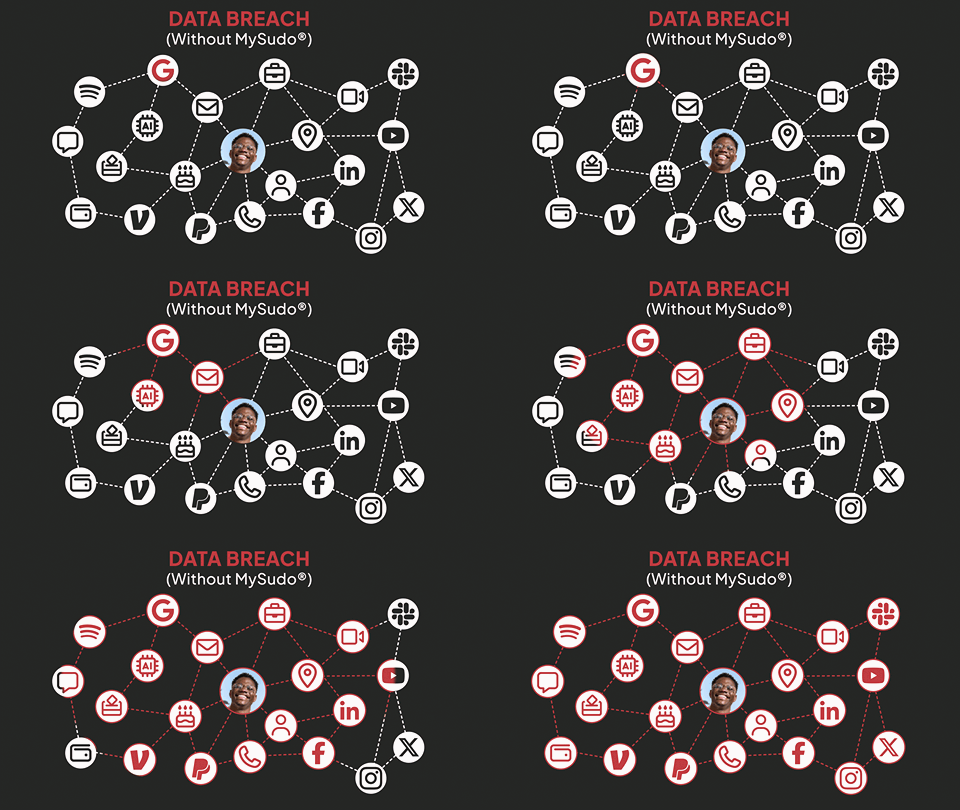
The graphic below shows the problem with using one identity in your online activities. When a data breach occurs, everything involved can be exposed and linked to you. Data brokers can use it to build a complete picture of your life, and this valuable information is sold.
Artificial intelligence (AI) systems have greatly exacerbated the problem.
Data brokers can now use AI to connect your various actions in a way previously thought impossible. AI’s expertise is data analysis, working with vast amounts of information to map your actions into a valuable profile.
In this world of surveillance capitalism, can we swing the privacy pendulum back in your favor? Is it even possible to be private, secure and safe online?
Every account you sign up for and every form you fill out is linked back to you.
MySudo breaks that trail by letting you create multiple digital identities, each with its own phone number, email, payment card, and more, as a new set of credentials you can use so you stop giving away your personal information by default.
Personas and compartmentalization
If surveillance capitalism works by bundling everything about you into one usable profile, the countermeasure is structural (not just legal or political): break the correlating identifiers.
This is the premise behind compartmentalization. Instead of using one set of identifiers like one email, one phone number, one payment method, one communication handle in every context of your life, you consciously separate activities into separate, purpose-built personas.
One persona for online shopping, a different one for dating apps, another for travel, a third for marketplace listings, and even a third for that newsletter you’re still not sure you trust.
Each persona operates as a separate identity with its own email address, its own phone number, its own payment method, its own browser and its own communication handler. Most importantly, these identities are not linked to each other or back to your actual identity in any way that a data broker or advertiser could monitor.
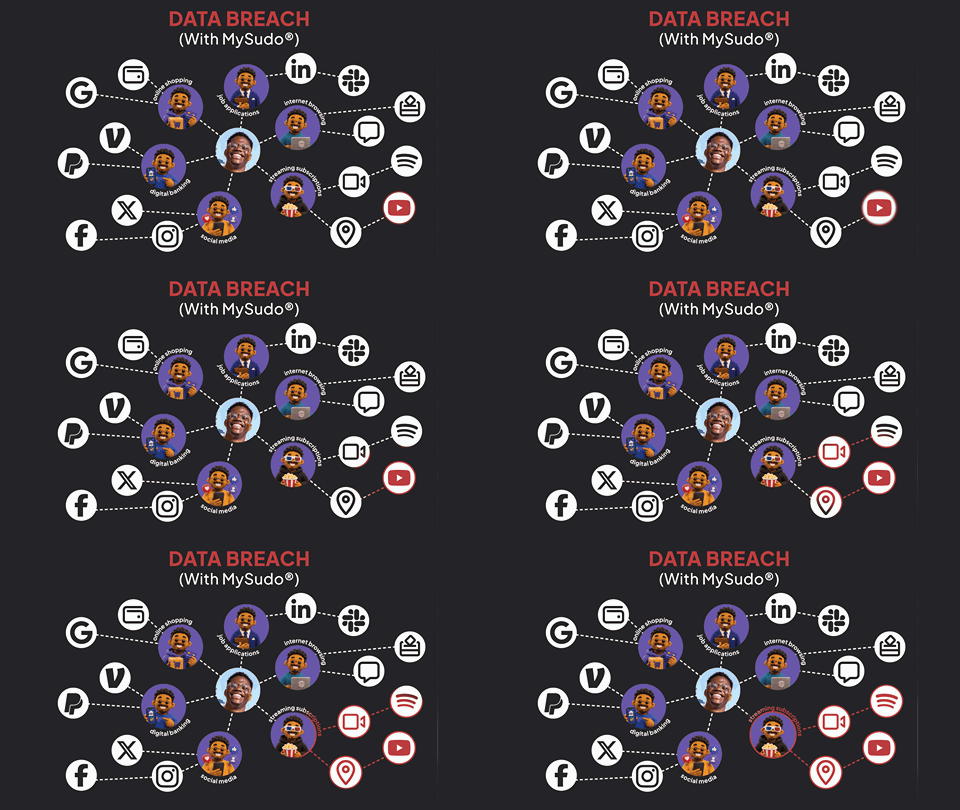
As shown in the graphic below, if an individual gets swept up in a breach, starts attracting spam, or is sold to a marketing list, the damage is limited and not tied to you.
This is a fundamentally different privacy model than most security tools rely on. Most tools try to protect an identity better with stronger passwords, better encryption, more careful permissions.
Compartmentalization instead assumes that each individual identity will eventually become correlated and provides adjustments by ensuring that no one identity is valuable because of its variability. This process is less about building an impenetrable wall and more about not putting all of your value behind a wall in the first place.
The elegance of this approach is that it doesn’t require changing the rest of the Internet. Not every company you interact with needs to suddenly adopt better data practices. You just need a layer that stands between you and them, generating and managing these personas on your behalf.
Anonymome Labs has patented many of the ideas related to creating online personas and segmentation, here are some examples:
How MySudo puts this into practice
Separation and personas are important advances, but the harder problem (and the one that occupied most of our product decisions) is making it usable by typical users and automatic enough that people can do it consistently, without a computer science degree and without constant friction.
As shown in the graph below MySudo was designed to implement this paradigm and allow each user to create up to 9 personas or Sudas. Each sudo provides a different:
- phone number that can make and receive phone calls and SMS;
- Email inbox who can send and receive emails;
- Virtual payment card for online shopping;
- Communication handle to enable encrypted end-to-end (E2EE) messaging, voice and video calls (similar to WhatsApp);
- Browser for complete separation of surfing.

MySudo comes in two form factors:
- A mobile app for iOS and Android which allows any person to communicate externally with phone calls, SMS and emails. Allows creation of individual payment cards and end-to-end encrypted messaging, email, voice and video. It also has a separate browser for each personality.
- A desktop companion app for Windows and Mac which enables personal email management in a form factor that provides support for longer and more complex emails. More features are coming soon to the MySudo desktop app.
MySudo is part of a growing family of privacy and security apps from Anonymome Labs that also includes privacy-focused VPN and Password manager (expect soon).
Individual online privacy has been under surveillance and attack almost since the dawn of the web—and now users have identity-based tools to fight back. By creating multiple personalities that allow you to compartmentalize your life, you can also reap the benefits of privacy.
Your identity is now being assembled. Stop streaming the pieces.
Download MySudo now to create separate digital identities that keep your personal information private and inaccessible to data brokers, fraudsters and the next data breach.
Sponsored and written by ANONYMOUS LABS.