When a client named Rusty contacted crypto recovery expert Chris Brooks in 2021, he said he and two others won 5,000 bitcoins in a court case, worth about $53 million at the time.
They immediately set up a Zoom call to discuss the case.
“There were three people on the call, and one of them was holding a phone. It had like $53 million in a bitcoin address,” said Brooks, founder and CEO of Crypto Asset Recovery.
The men claimed they were able to withdraw as much as $300,000 a week but wanted out the entire fortune. If Brooks and his son, Charlie, fly to Georgia to help crack their wallets, they’ll make them millionaires.
Brooks and son bought plane tickets and left the next day.
At lunch, Rusty, a 6-foot-3 Army veteran, revealed that the wallet contained not only 5000 BTC.
“Rusty pulls out his phone, and he shows us a billion dollars in ETH. And that’s when I think, OK, something very strange is happening here.”
The men then drove about an hour to a strip mall owned by one of them, where they went to the back office and handed over notebooks containing dozens of recovery seeds. The pair spent the day opening wallets.
They found about $10 in bitcoins.
Brooks never established whether the wallets they provided were previously BTC or ETH Rusty claimed to own. They were never reimbursed for the flight tickets either.
Related: Does the Coldcard attack mean all hardware wallets are now insecure?
Brooks now suspects Rusty fell victim to scammers who convinced him he had a large crypto fortune when he didn’t.
This was an early lesson for their crypto recovery business.
Sometimes crypto gets lost. Sometimes the wallet gets lost. Sometimes passwords are lost.
And sometimes, it turns out, the money wasn’t there in the first place.
Losing your crypto doesn’t always mean it’s gone
For wallet recovery experts, “lost crypto” can mean many different things.
They are not retrieving bitcoins from the blockchain; They are retrieving information needed to access an already existing wallet.
Even if someone drops a hardware wallet, forgets a password or part of their seed phrase, none of these things necessarily mean the underlying crypto has disappeared.
Bruno Krause, co-founder and chief technology officer of recovery company ReWallet, told the magazine:
“If you have some missing words, you can often recover them.”
Bitcoin’s BIP39 seed phrase value by using A list of 2,048 words, meaning that if someone knows most of the words, experts can sometimes systematically search for remaining possibilities. The fewer pieces missing, the more manageable the puzzle.
Password recovery can work in much the same way.
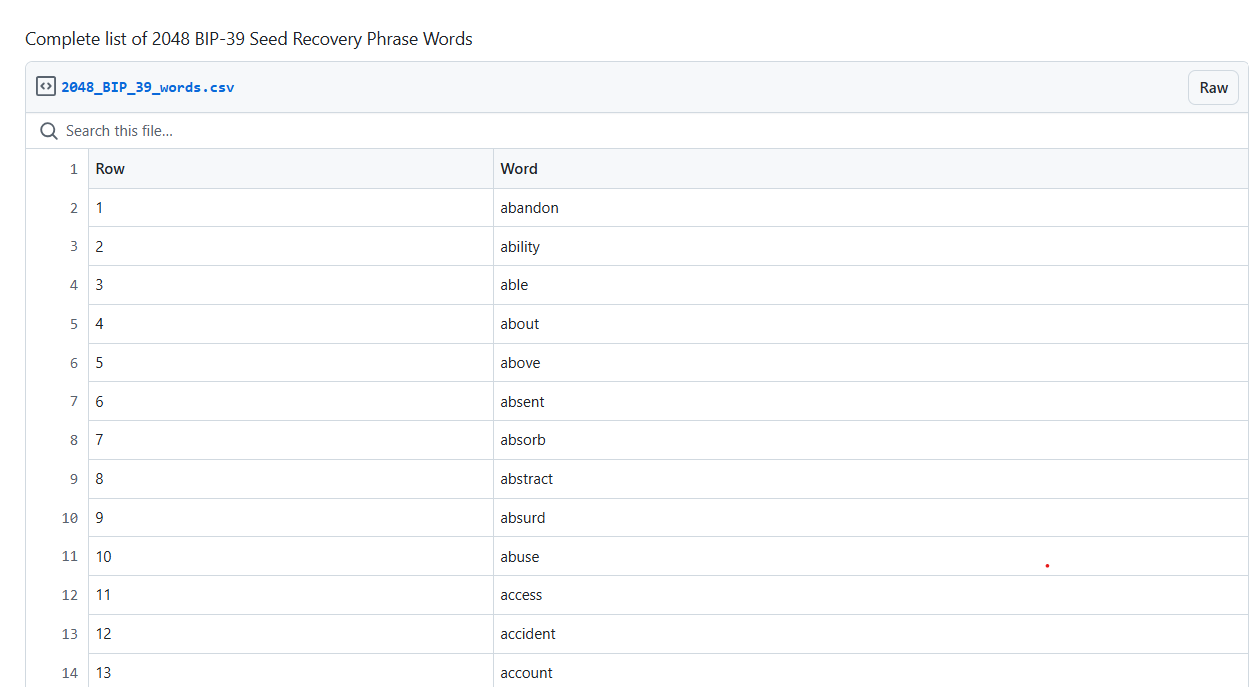
BIP39 Value of Bitcoin by using A list of 2,048 words. Source: GitHub
Krauss said ReWallet once recovered a 20-character password that saved about $3 million after reverse-engineering a faulty password generator.
Other cases rely less on technical work than on understanding how a particular person creates a password.
This means asking clients about personal preferences such as favorite foods and places, children’s names and birthdays, personal milestones or memories.
In one case, he says a customer was convinced he had used his children’s names, only to remember that the password was actually a phone number connected to a local delivery service:
“He didn’t know why, but then he thought about it, and he realized, oh, well, because on this day I delivered the package to the store, and I thought, well, that would be a nice password.”
Passphrases add another layer of complexity
Tom Bennett, a bitcoin academic who studies wallet security, says there’s another particularly confusing category: passphrases.
A passphrase is an additional piece of information layered on top of a seed. Enter a different passphrase, and you won’t necessarily get an error message You can simply get another valid wallet. He told the magazine:
“An incorrect passphrase does not throw an error; it succeeds and shows you a zero balance.”
So you can get the correct seed phrase and enter it correctly and still think your BTC has disappeared.
“Passphrases have no features to protect users from themselves; no list of 2,048 valid words, no checksum. So if you’ve forgotten a passphrase, it’s the same question again: How random was your passphrase? If it’s random enough, there’s no way to recover it.”
With a lost or broken hardware wallet, even having a broken device doesn’t always help much. If the wallet’s backup seed phrase survives, the keys can usually be recovered on another device.
This is why recovery experts don’t necessarily need the original hardware, but enough information to reconstruct access to the keys.
Related: Irish police open Bitcoin wallet years after keys go missing
Recovery can also mean correcting mistakes rather than recovering lost wallets. Crypto sent to the wrong blockchain, such as BNB to Ethereum, can sometimes be recoverable if the receiving wallet is under user control.
Brooks said that Crypto Asset Recovery contracted to crack more than 3,000 wallets of about 1,500 people and cracked the passwords of about 63% of them.
Sometimes you really lose it
But there is a hard boundary. Bennett said:
“If your seed is really random and you lose it completely, your bitcoin is gone.”
This is one of the fundamental trade-offs of self-preservation. A Bitcoin wallet does not have a bank-style recovery system or a central administrator who can verify your identity and recover your account.
Lucien Bordon, Bitcoin analyst at hardware wallet maker Trezor, puts it more clearly. If the wallet backup is lost and the wallet containing the keys is inaccessible, “no recovery agency can help.” He warned:
“If they could, the wallet could crack and self-preservation would be fundamentally compromised.”
Thanks to randomness, crypto wallets make it effectively impossible to guess a private key. In the recent case of Bitcoin hardware wallet Coldcard, a firmware bug weakened seed randomness in some wallets, making the seed comprehensible without physical access.
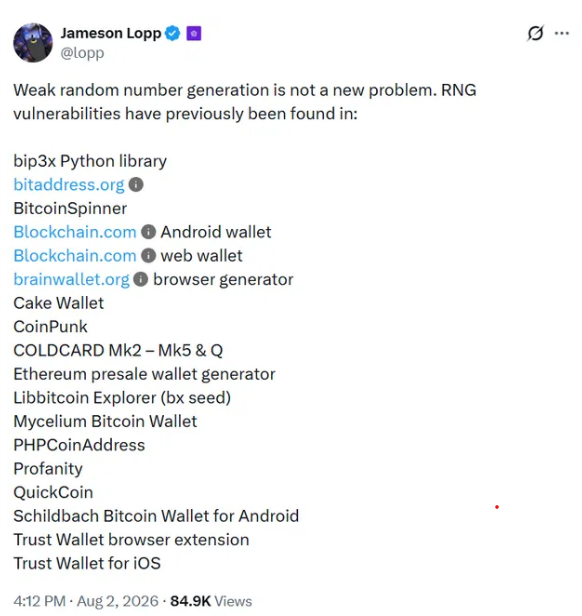
Weak random number generation is not a new problem. Source: Jameson Lope
But if a truly random seed or private key is completely destroyed, the number of possibilities is very high.
Krause says that recovery experts can sometimes find technical paths into wallets that owners assumed were permanently inaccessible, and that outdated wallet software, malicious files, poorly crafted passwords and hardware vulnerabilities can all create unusual opportunities:
“Don’t give up on the edge.”
Recovery experts can sometimes be scammers
There is an uncomfortable irony in the recovery business.
The person who might be able to help you regain access to your crypto needs the information that gave someone access to it.
A seed phrase is not like a password that can be changed after someone sees it. Anyone with the necessary wallet backups can often control the funds.
This makes choosing a recovery specialist a safety decision in itself. Bourdon says:
“If you decide to do this, do your homework. Look for companies with a real track record and reviews that you can trace back to real customers. Check if they charge on success rather than up front. And when you return, move your funds to a new wallet with a fresh backup.”
He said users should also be wary of any unsolicited messages claiming that someone can recover their funds.
Krause said other warning signs include pushing users to WhatsApp or contacting them from personal email addresses like Gmail, demanding upfront payments or asking them to open accounts on exchanges.
Recovery firms that charge a percentage of successfully recovered funds are not uncommon; But anyone promising to recover wallets should ring alarm bells for upfront payments.
Brooks learned another lesson from the Rust case.
While crypto recovery may sound like a technical task, a person who believes they are sitting on millions or billions of dollars can also be a security risk.
Crypto Asset Recovery no longer flies out to meet clients in person as Rusty did. The company now manages cases remotely, with sensitive wallet information processed through an automated and air-gapped system.
Brooks says they hold about 71% of cracked wallets under $100, and the company doesn’t charge a fee for recovering assets under that amount.
If he wishes crypto users knew about asset recovery, it’s:
“Learn what a recovery seed is in the world and why they matter. This is the easiest way to make sure you never have to talk to us.”
magazine: Mystery surrounds why an OG burned through $1M in Bitcoin
Cointelegraph publishes long-form journalism, analysis and narrative reports with subject-matter expertise developed by Cointelegraph’s in-house editorial team. All articles are edited and reviewed by Cointelegraph editors according to our editorial standards. Some articles contain affiliate links, from which Cointelegraph may earn commissions. These relationships do not influence which products we review or our editorial decisions The content published here does not constitute financial, legal or investment advice. Readers should conduct their own research and consult with appropriate professionals. Cointelegraph maintains complete editorial independence.