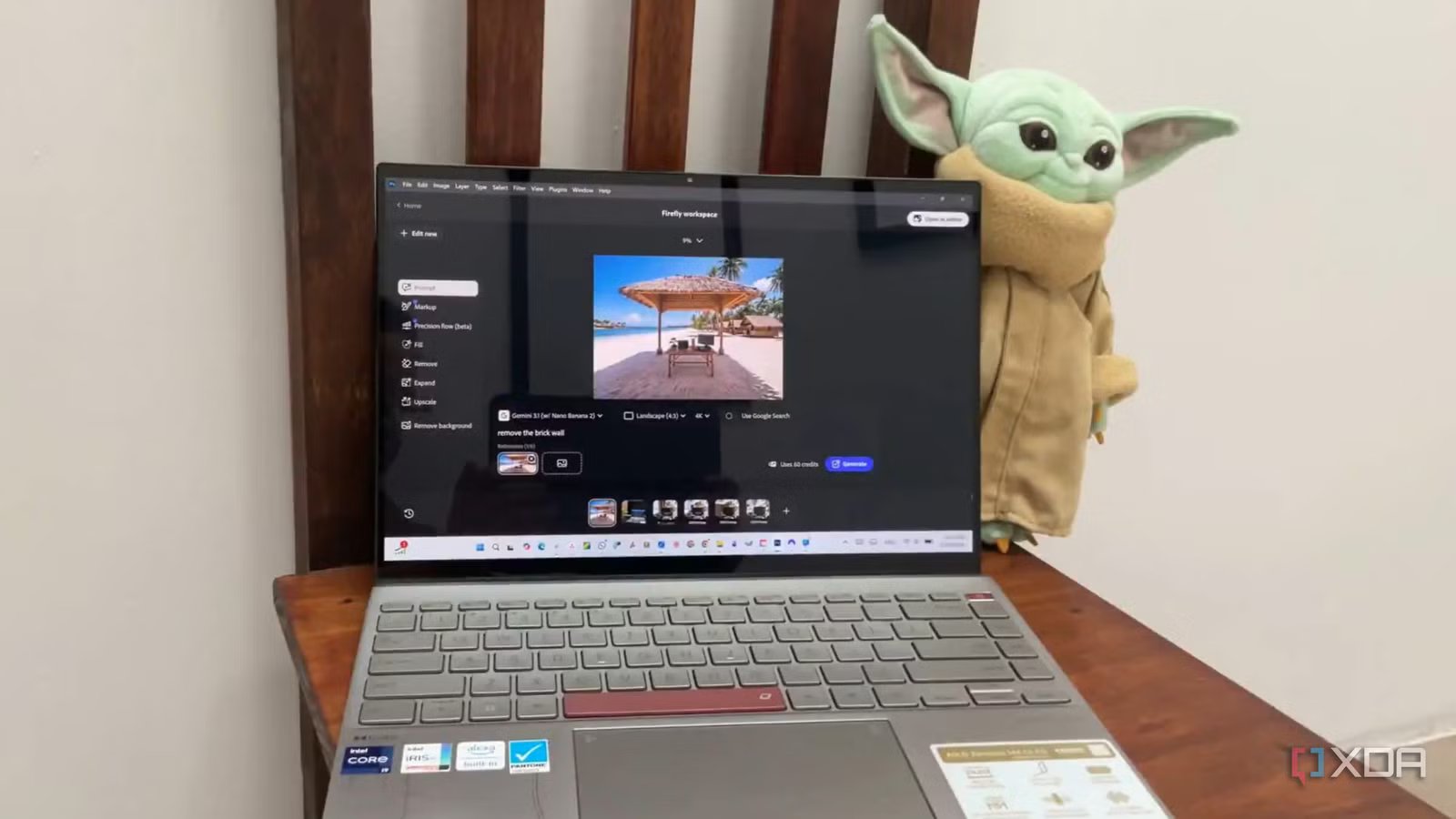
To whom If you use Adobe Creative Cloud, the full suite costs $60-$85 per month and over $1,000 per year, plus forced AI stacking andcontroversial Terms of Service updates.
As if that wasn’t bad enough, many plates operate underground. Installing Creative Cloud isn’t just about installing apps. It actually introduces 15+ background daemon processes, telemetry trackers, and high idle CPU services that slow down boot times and eat up system RAM.
There is a whole range of open source creative software that you can use, and they are no longer stuck in the era of ugly broken Linux tools. Instead, modern open source creative tools offer GPU acceleration, non-destructive processing pipelines, and professional color spaces. Ditching Adobe Creative Cloud for open source alternatives is ultimately a viable option, and it won’t just save you money. It truly frees your PC from invasive background telemetry, provides true file sovereignty with open formats, and provides a faster, less disruptive workflow that runs entirely on local hardware.
Similar swaps
There is a range of open source tools
Virtually every Adobe tool has a port, and virtually every replacement meets or exceeds the Adobe standard. For those who use Photoshop a lot and are looking for an alternative, GIMP 3.0 is a great option. With a recent UI overhaul, it offers non-destructive layer effects and proper handling of the CMYK color space. For those who need Photoshop not only for photo editing, but also for illustration software, you can opt for Krita, which allows for specialized digital painting, raster animation, HDR canvas painting, and brush engine mechanics that go beyond Photoshop.
If you use Illustrator, then Inkscape is a great alternative. It’s an SVG-first architecture and features advanced node processing, logical string operations, and multi-page document support without forcing assets to be stored in the cloud. All of your assets are stored locally on your personal hardware, so you don’t have to worry about the cost of an additional cloud storage subscription when your files get too big.
Lightroom is such a fantastic editing program that for a long time it was difficult to find an alternative, but now a dark horse has entered the scene. It offers scene-referenced color sorting pipelines, fully non-destructive 32-bit floating-point raw processing, and export capabilities with catalog corruption or subscription gating.
Content creators and filmmakers may be looking for alternatives to Premiere Pro and After Effects, and Kdenlive, Blender, and Natron. Kdenlive is a lightweight, multi-threaded timeline editing software based on MLT with hardware-accelerated NVENC/VAAPI rendering. If you are creating 3D models, then Blender is a great software. For motion graphics that fully compete with After Effects, you can use its node-based compositor, 3D tracking engine, and video sequence editor.
Other benefits of switching
Saving money isn’t the only benefit

In addition to cutting costs, you’ll achieve a huge architectural win by switching to more of this open source software. This is because telemetry has lower system costs and you also get the benefits of open formats. Unfortunately, Adobe Creative Cloud runs a lot of background services every time you open the app. Removing the Adobe daemon kit eliminates persistent background memory leaks, GPU sleep wakeups, and intrusive update notifications.
When you use Adobe Creative Cloud, you’re also locked into proprietary formats like .psd, .ai, and .prproj. For many people, it’s easy to overlook why this might be an issue, but what it really means is that when you cancel your Adobe subscription, your ability to edit your historical project files is compromised. By choosing an open source alternative, you can preserve your files in open standards, ensuring that your work remains available decades from now, regardless of licensing conflicts and issues.
You also get the benefit of total offline functionality, as the fully open-source software doesn’t require a 30-day online license like Adobe does. This means you can continue to use the software even if you are completely offline. It requires registration once a month to function properly and also depends on cloud sync.
There are also disadvantages
Unfortunately, not everything is perfect

There are a few downsides to switching to open source software. The first one will be the problem of muscle memory. When I first switched, I noticed that there was a lot of initial friction. Having used Adobe Creative Cloud for years, all the shortcuts and tools are like second nature to me. Learning a new set of keyboard shortcuts, tool paradigms, and level control structures took time, but after a few weeks of relearning the workflow, it was easy to overcome.
Collaborative friction is harder to overcome because Adobe Creative Cloud has become the industry standard. Sharing local project files with agency clients that require .ai or .psd layered files can be frustrating. You can export to more compatible intermediate formats like PDF to bridge the gap, but that doesn’t always solve the problem.
If you’re someone who takes advantage of Adobe Creative Cloud’s generative AI integration, then the full Open Source package may not be the best option for you. Although open source tools allow additional integration with native AI models, they must run directly on native GPU tensor/CUDA cores. Of course, this means you’ll get the benefit of zero data collection, but it also means you’ll need a powerful enough desktop or laptop to do the job.
Creative Cloud is awesome
Too bad it’s too expensive
Unfortunately, what started as a fantastic set of tools in Adobe Creative Cloud quickly turned into a perpetually recurring revenue stream for one corporation. Modern open source tools have reached a level of maturity where you don’t need to compromise software quality to escape the subscription cycle.
Before you cancel your Creative Cloud subscription, why not download these free open source tools, try them out, and decide if they’re for you? If you like them, it might be time to finally ditch your monthly payment to Adobe.