
Solid-state batteries have long been promised the holy grail of energy storage. They promise to double the energy density of conventional options, shorten charging times and eliminate the risk of thermal fires. Still, the technology is not yet widespread, and the main culprit is dendrites. These microscopic, needle-like structures form inside solid-state batteries during charging, piercing the solid ceramic electrolyte and bridging the electrodes, causing a short circuit.
They are now researchers at SLAC National Accelerator Laboratory and Stanford University discovered a surprisingly simple solution to this persistent problem. According to an article published in a scientific journal NatureControlled mechanical pressure on the ceramic electrolyte prevents these short circuits, allowing test cells to survive thousands of charge cycles without failure.
Redirection of internal growth
For years, scientists debated whether dendrites form on the surface of the electrolyte or deep within its internal structure. Using SLAC’s advanced X-ray instruments, the research team solved this question, revealing that dendrites originate from nanoscopic internal pores and defects within the material.
To counter this, the researchers used basic fracture mechanics. A shape memory alloy ring was placed around the solid electrolyte and heated to 170 degrees Celsius. As the ring contracted, it exerted a strong, continuous lateral pressure on the cell.
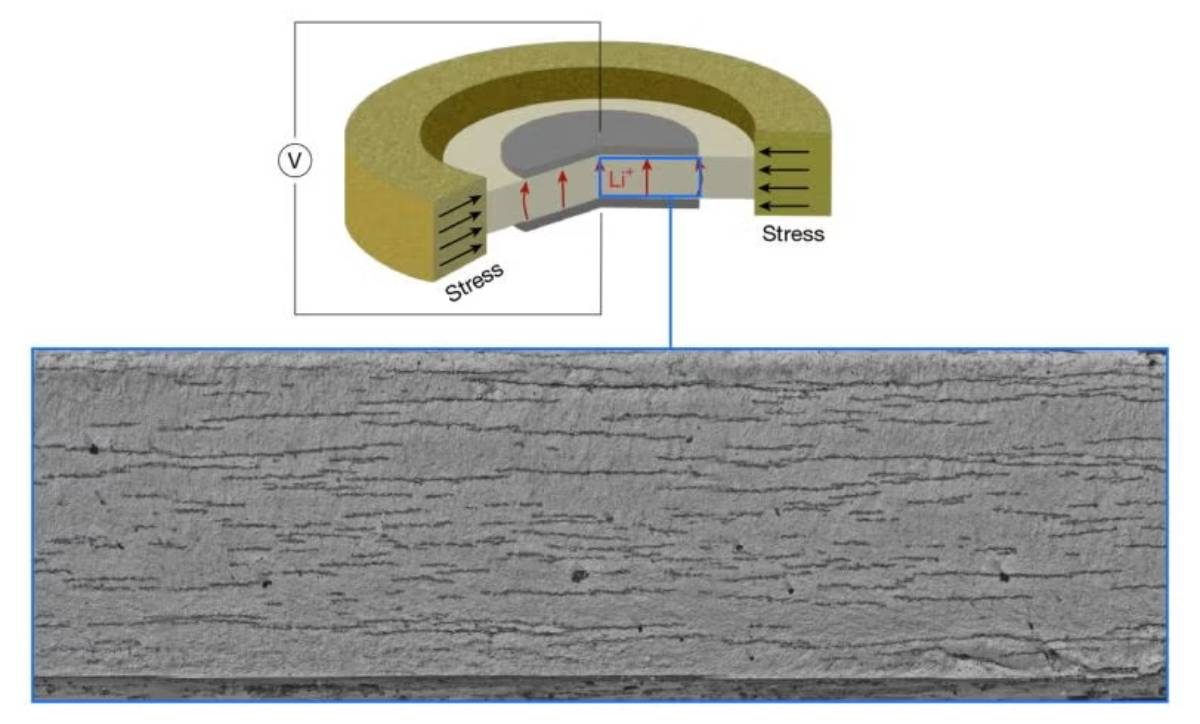
The result was striking. As a result of the mechanical compression, dendrites still formed at the site of the internal defects, but the physical stress changed their growth path. Instead of growing vertically toward the electrodes and causing short circuits, the dendrites grew horizontally. Safely encased in the electrolyte, they could no longer cross the gap between the components to kill the battery.
Impact on everyday technology
While the research is currently in the laboratory stage, using mechanical pressure to stop dendrites in several key sectors opens a clear path to real-world devices.
- Electric vehicles: In the case of electric vehicles, doubling the energy density means a significantly longer range and lighter vehicle weight. Preventing short circuits allows these packs to handle fast charging protocols while reducing drivers’ range.
- Entertainment electronics: Battery life for smartphones, laptops and wearables could be dramatically extended in thinner designs if production sizes take effect.
- Grid energy storage: Large energy grids require storage for thousands of cycles. Solid ceramic electrolytes provide non-flammable stability, and mechanical compaction helps ensure long-term reliability.
The research proves that removing dendrites may not require a miraculous, flawless ceramic material. Relying on basic mechanical pressure, it provides a clear, more realistic path for engineers. Designing batteries with built-in compression mechanisms could be the shortcut needed to finally get solid-state batteries out of lab testing and into the real world.
\