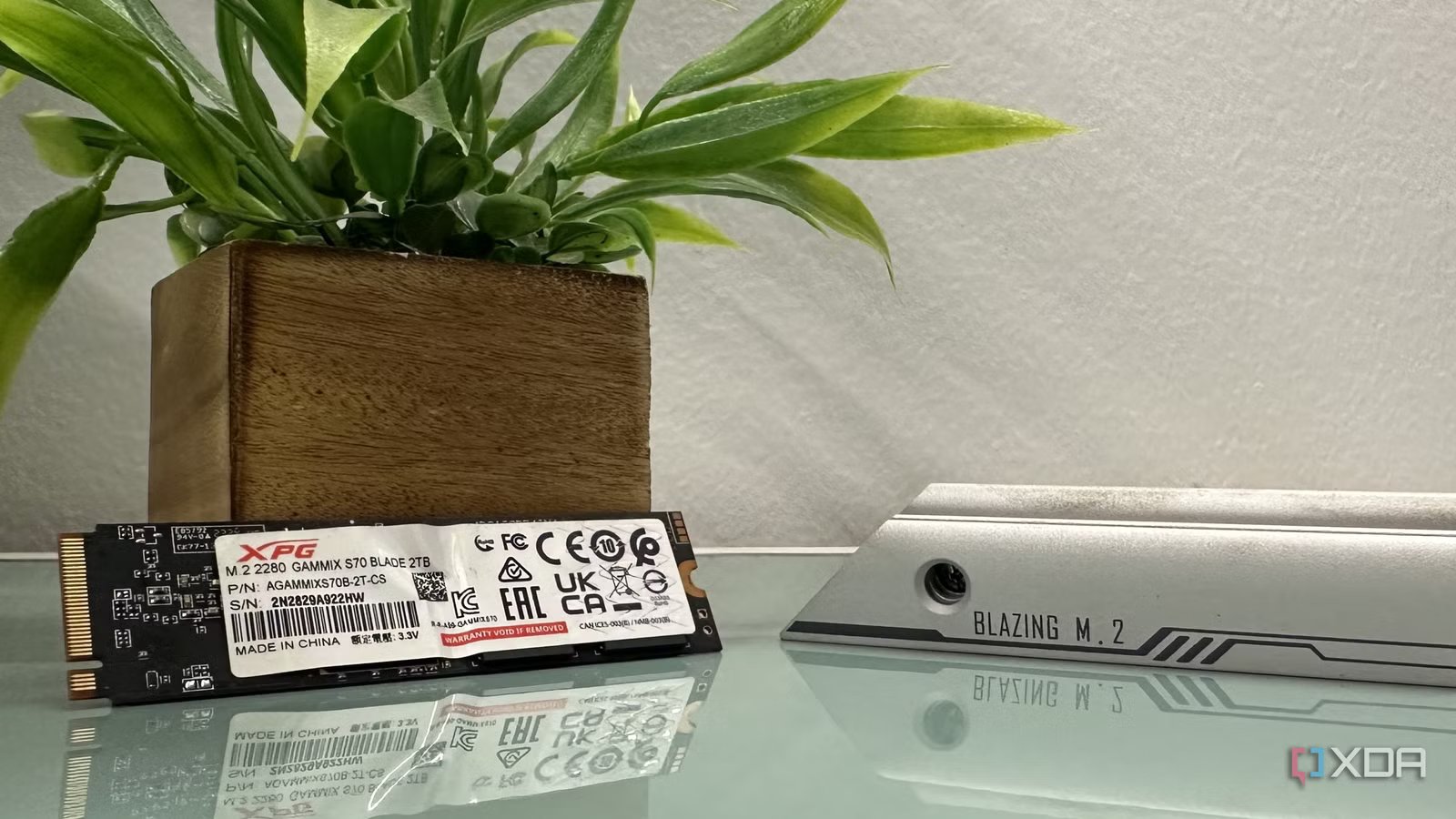
In 2020, PCIe Gen 4 NVMe SSDs were the most popular choice for PC builds, and the box-office numbers sold attracted huge enthusiasts. As someone coming off SATA SSDs, reading sequential speeds of up to 7000MB/s on the box made the former look positively ancient.
When I got the XPG S70 Blade, I had high hopes and the drive count and offer was twelve times faster than the storage solution they included. So, of course, I was surprised to see that the PC boot time, game load time, and app launch time were almost the same after the switch.
It’s clear that the biggest leap in storage performance happened a few years ago, and what’s important to my user experience has had very little impact on what the update has to offer.
My fastest SSD doesn’t seem to affect my experience
The biggest performance jump was

I vividly remember the anticipation I felt after installing a Gen 4 NVMe SSD, which was cutting edge in 2020. I pressed the power button and watched the Windows logo pop up and shut down and proceeded to log in to launch every app I was using. Part of me was waiting for the desktop to feel faster like it did when making the jump from spinning HDD to flash-based storage.
It took me less than an hour to realize that my expectations were wrong. I took the number twelve as a sign that the whole system was suddenly faster by that factor. Instead, each of the tasks I mentioned was five or maybe six seconds faster than usual.
NVMe SSDs solved the problem I didn’t have
SATA SSDs have already crossed the chasm

I’d say the biggest surprise of this shift has to do with how the game’s load times behaved. It was one of the first games I decided to run with the new save configuration Grand Theft Auto V, because if there was any game in my library that could benefit from faster storage, it was a game that was notorious for its long load times. However, the upgrade brought me to Los Santos five or six seconds faster. I don’t want to say it wasn’t a nice improvement, but it was neither night nor day what I was hoping for.
I was introduced to PC gaming from an Xbox One X that uses a mechanical HDD. Anyone who’s played any AAA title on a 2017 console knows that it’s an efficient zone where load times are measured in minutes rather than seconds. The move to SATA III SSDs in 2020 thus effectively shaped how I feel about “upgrading”, so it’s only natural to jump from SATA to NVMe in this comparison.
As the rest of my library repeated the same story, it was clear that the order of the reception sequence was random from HDD to SSD, and that the SATA SSD was fast enough to saturate my reception. The top of the Gen 4 interface, on the other hand, is almost never touched during normal use.
Redundancy is important in a specific workload
The high consistent speed is great, just not what I thought it would be

To understand the real advantage that Gen 4 NVMe gives to a desktop SATA III SSD (as I’ve learned) requires understanding how to build it. Both architectures are unique communicates through each at the interface level. My old SATA SSD was tied to a connection made in the era of hard drives, and that link was around 550MB/s. The Blade skips that hassle and communicates with the system over the PCIe bus, which can transfer data ten to twelve times faster as advertised.
Now one may wonder why there is such a huge gap between the two accepted speed and the speed at which the data is moving shown in the box. This happens because the number describes only one method of reading data, which is sequential access. This is important in real workloads, and it only applies to large, continuous file transfers.
Every other aspect of the PC user experience, on the other hand, studies random I/O performance. Booting into an operating system, opening an app, or loading a game is a random access and depends on thousands of tiny 4K reads scattered across the disk, requesting a couple at a time. In this particular type of workload, both drives drop to a fraction of their rated speed and the gap between them closes.
|
4K random read |
SATA III SSD (860 Evo) |
PCIe Gen 4 NVMe SSD (XPG S70 Blade) |
PCIe Gen 5 NVMe SSD (T700) |
|---|---|---|---|
|
QD1 (boot and load workloads) |
40-45 MB/s |
80-85 MB/s |
80-90 MB/s |
|
QD32 (Synthetic Indicators) |
380-400 MB/s |
1600-2500 MB/s |
2000-2800 MB/s |
|
Read sequentially |
550 MB/s |
7000-7400 MB/s |
12000-12400 MB/s |
Another aspect that affects NVMe SSD performance is the role of CPU decompression. The Blade can move data over the PCIe bus at several gigabytes per second, but game assets come compressed, and the processor you have to unpack them with typically manages 1–2 GB/s. This basically means that the disk is delivering data faster than the CPU is delivering it to the GPU, which provides this ceiling.
There is a lot of misunderstanding about what SSD upgrades mean
If the SATA-Gen 4 NVMe jump barely moved my day-to-day experience, I’m sure a Gen 5 drive with nearly double and double the sequential speed wouldn’t either. In most tasks relevant to the average user’s daily workload, the random I/O rate is the defining experience, not the bandwidth of the subject.
It is not uncommon to see users making purchasing decisions based on the latter. Until your workload really saturates your sequential bandwidth, buying the fastest SSD on the shelf becomes an exercise. chasing diminishing returnsand it’s a lesson learned the hard way.