No user of any operating system wants to entertain the thought of a complete rebuild when things are going well, but sometimes disaster happens. I haven’t had to deal with this myself on Linux, but it can happen at any time: a failed drive, a bad upgrade, a misconfigured partition table, and many other failure modes exist and are encountered by users every day. These are the 7 things I would reinstall and reconfigure first if my setup were to suddenly disappear.
My dot files, sourced from Git
An underrated backup

This is the only item on the list that isn’t actually software, but a collection of files. The dotfiles repository acts as a quick way to restore all configuration files that reside in my home directory. They usually represent months of small changes you’ve made over the course of months, in the form of shell and aliases, invocation, terminal emulator settings, editor configuration, and desktop tweaks that suppress annoyances that fall due to defaults.
This is number one on the list. When the shell behaves exactly as I expect, it will be faster to install everything below this, because configuring the system using a call you are not familiar with can slow you down significantly. Setting up your own dotfiles repo is one of the cheapest insurance policies on Linux, and it’s something most people don’t think about until it’s too late.
Password manager and browser synchronization
Non-negotiable to bring everything else back online
Dot files return a terminal, but what about the rest? The password vault is the next important thing, because until I have all my logins, I can’t use anything else. Restoring this is a second order of business before setting up my browser. Browser sync is another important part and I personally rely on Brave Sync for this. A simple password that I can copy from my phone and every part of the browser syncs, just like any other system.
Pictures
Included in some distributions, but not all

Images are an integral part of preventing disaster when installing Linux in the first place, but whether or not you should do this depends on what you’re installing. openSUSE has shipped Snapper over Btrfs by default for years, and several Arch-derived distributions comply. On my CachyOS distro of choice, snap-pac is bracketing each pacman transaction with before and after snapshots before touching anything. Linux Mint installs Timeshift, but leaves the configuration up to you, which will catch people who hit the welcome screen without much thought. Then there’s Fedora, which has defaulted to Btrfs for years, but doesn’t ship any image tool, so you don’t get the file system’s features and any of its conveniences until you install it yourself.
GPU stack
Usually not the driver, but everything else

The driver itself is not a concern in any modern distribution. Often, a functional, up-to-date driver is included in the distribution installation, so there is no need to install it. My only concern after a fresh install is the tools around.
LACT is a piece I want to bring back immediately. It’s the only graphical interface for monitoring, fan curves, power limits, and clock control, and it covers AMD, NVIDIA, and Intel hardware. NVIDIA went a long way, opting for a PowerMizer mode to force the card to peak performance, and a voltage boost slider that developers directly compare to the equivalent in MSI Afterburner. The Blackwell cards got specially tuned hotspot temperature readings and memory temperature sensors on the same chip, which is important if you’re on a 50-series card like I am.
Mesh VPN client
Needed to access other devices on my network

Now that my setup is in working order, it’s time to add it to the other important stuff. In my case, it’s NetBird. The Tor VPN client puts the new installation on the same overlay network as everything else I have, like my other devices, my home lab, and my phone. Without it, I’m disconnected from my managed services and NAS, so this is a must.
Flatpak and Flatseal
Flatpaks are essential, but you need Flatseal to properly configure them
Flatseal is a permissions editor for Flatpaks, so this post is actually two things, but one package that configures installation on distributions that ship Flatpak.
The sandbox provided by Flatpak is really useful, but also opaque. Flatseal makes it much more intuitive, exposing environment variables in a truly readable interface without requiring filesystem access, device logins, sockets, and manual manipulation of override files. An example that comes up regularly is an application that can’t see a drive mounted outside of your home directory, which is a one-click switch with Flatseal.
Btop
My favorite tracking program
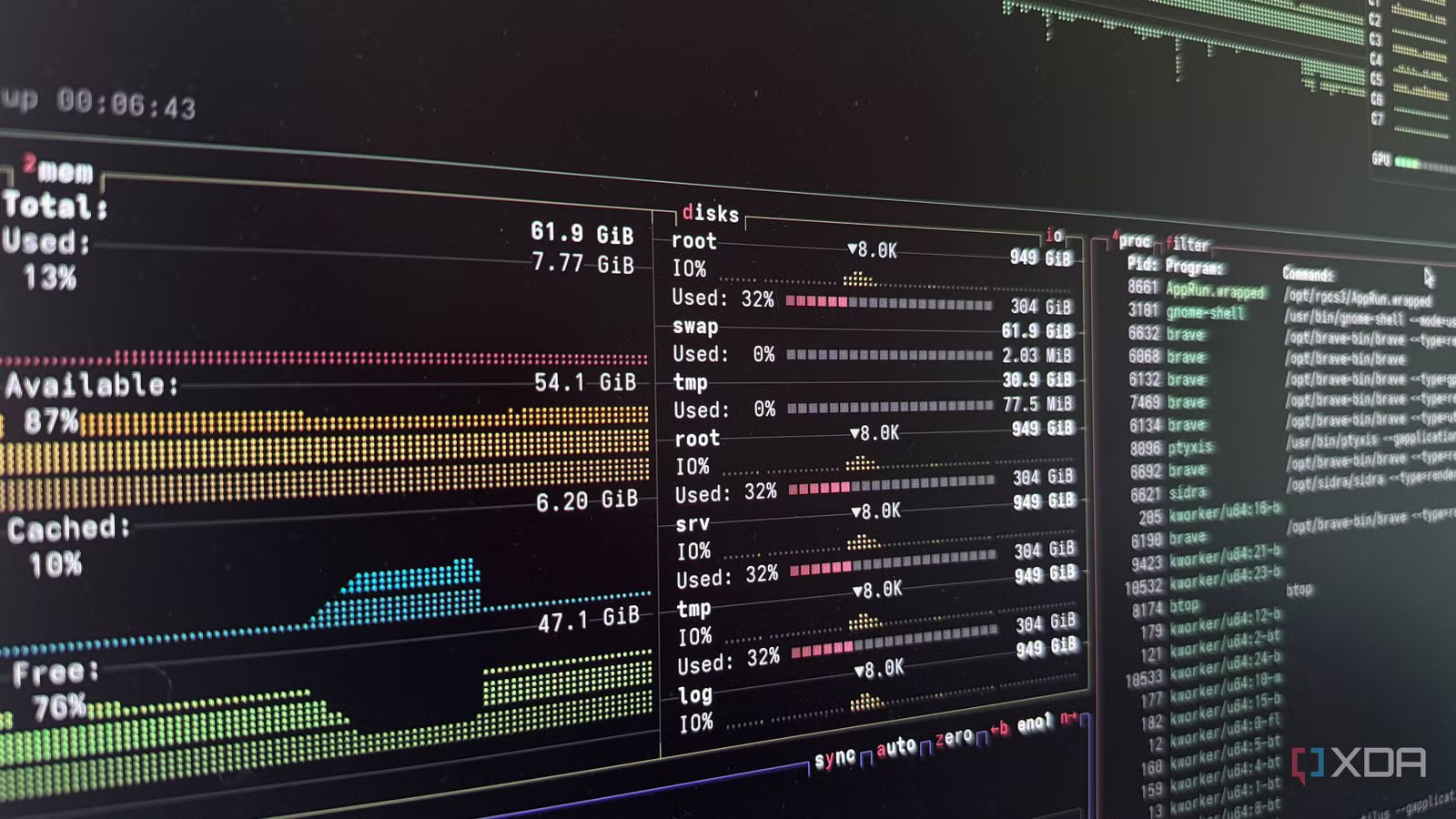
The last thing I’ll install isn’t something I think is essential, but it’s something I use often. Btop is a task manager application that shows you everything you need to know about the hardware on your system. The idle CPU and memory base is the first thing to look at after a fresh install, but it’s great for viewing temperatures, I/O, network status, and other performance metrics.
A list I hope I never have to use
If you get something out of this, make it the first item. The dotfiles repository is the simplest way to restore basic terminal and desktop functionality, and it only takes a few minutes to install. Everything else, including apps, can be replaced in an hour or two. Configuration decisions aren’t made, and sometimes it takes months to reflect a change you’ve made before things really go wrong.