I admit to something embarrassing for someone who writes about display technology for a living. My last TV was in factory picture mode for the better part of a year. I struggled for weeks with the types of panels, my budget, and peak brightness numbers, and when it arrived, I plugged it in and ignored none of the settings. Now, to be fair, I use an Apple TV 4K with any display I watch movies on, and that’s it Set to Dolby Vision mode, so I may not notice that the TV is on a low setting.
But that is not the problem. The problem is that your TV ships at worst. Probably second worst because the ultra-mega-bright mode they use in the showroom is the worst. Manufacturers spend hours engineering to achieve reference color targets, then send the TV in a mode that throws off most of it for various reasons.
Filmmaker Mode is something everyone agrees on
If you don’t change anything else on the TV, that’s it

Ask any reviewer, professional calibrator, or AVS Forum regular what the most accurate out-of-the-box picture mode is, and they’ll all agree, unsurprisingly, that it’s Cinematographer mode. These are people who rarely agree on anything, so that’s high praise indeed. If you don’t have that option, Movie or Cinema will give you the most dials to turn to adjust, and that’s where most TV review sites start.
The peculiarity of the filmmaker mode is that it is not installed by any individual producer. This is a defined industry standard UHD Alliance in 2020so it works the same on LG, Samsung, Hisense or TCL and QLED or OLED devices. It locks the white point to D65, which Hollywood colorists criticize, and disables motion smoothing, sharpening, and noise reduction. Private-brand Cinema modes do the trick most of the way, but they’re never consistent from year to year, and some keep edge enhancement or cooler color temperatures in the mix.
Two notes about Filmmaker mode. Dolby Vision content ignores it and Dolby Vision cinema or Dolby Vision Dark where are exact equivalents. Your TV will automatically switch to these, so install Filmmaker anyway. Just know that sometimes it changes. And Sony redefines the movie maker mode as Professional on new TVs and moreDedicated in adults. Same idea, different words.
Yes, that shade of yellow is correct
When using Filmmaker mode for the first time, it may feel like the Mexican color filter is applied to everything. Not because it’s wrong; because you’re used to colder color temperatures and your eyes are adjusting to exactly D65 white point. Give yourself a few hours to see what you like before switching back. My brain thinks Standard the mode now resembles the bright dentist’s office I’m used to Film director.
Your TV was sent this way on purpose
All to earn an Energy Star rating
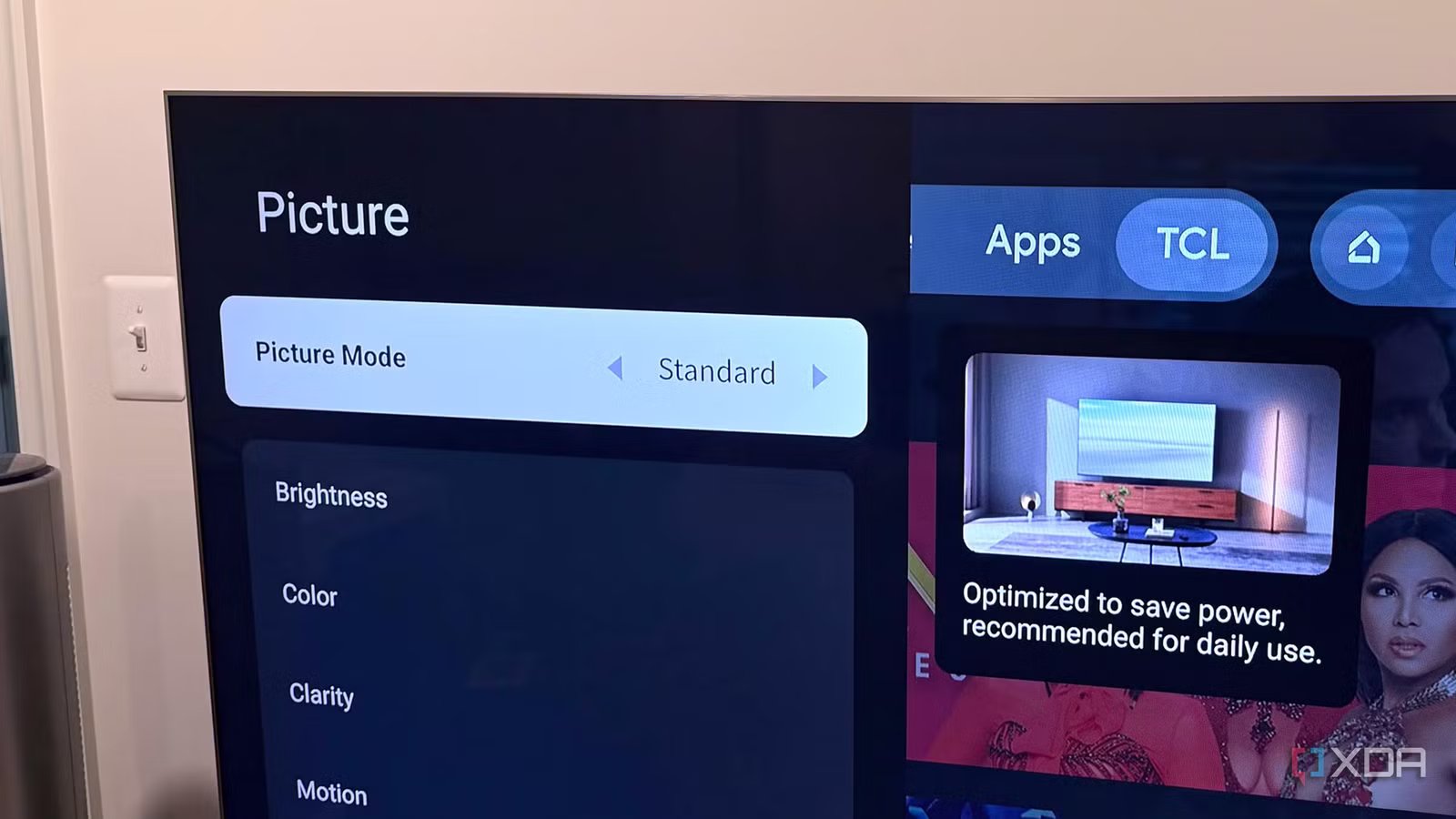
You may have heard that TVs come in Vivid mode to make them look impressive out of the box or look good in the store. It’s still somewhat true, but now there’s a Shop mode in the menus for that. But these days, a new TV usually comes standard with all the power saving features turned on, which gives the TV its own bonus. Energy Star rating.
It’s a big holebecause this setting allows them to be advertised as energy efficient, but this mode is not any have to run Turn on the TV when you get home. Regulations in the US, EU and Canada limit how much power a TV can draw, and in Eco mode manufacturers can claim that their TVs achieve thousands of nits of HDR brightness while staying on the right side of the rules.
This is how most manufacturers ship the TV to you, but of course some models will be different:
- Samsung: Delivered when Eco Mode is enabled in Standard Mode, then Intelligent Mode makes AI-driven adjustments on top of that. There are three barrier layers to find and Eco settings to disable before you can find and toggle Filmmaker mode.
- LG: Standard or AI image depending on the model year, Power saving setting is set Automatic. It’s driven by a light sensor that dims the panel aggressively, even in a bright room, and you’ll want to switch to Filmmaker and turn off Power Saver to get the picture quality you paid for.
- Sony: By default, Standard is the best option for accuracy, and switching to Professional mode will do the rest of the changes for you.
- TCL: Some models have a low power and eco-throttle mode installed by default, new sets have a cinematographer mode or a movie mode.
- Hisense: Comes standard with power saving and automatic light sensor. Again, the filmmaker mode is a play. If your room isn’t bright, try Theater Day.
- Vizio: Allows you to choose between Eco and Home during installation. Don’t choose Eco, you’ll end up with a blurry picture. Select Home, then Calibrated or Calibrated dark picture mode.
No need to update the panel, just 90 seconds with the remote control
Changing the picture mode is a good start

I’m not saying you shouldn’t upgrade your TV if you want to. The new panels are even better than two years ago, but they won’t show their best unless you adjust a few settings on the screen. You don’t need to be a calibrator or buy a colorimeter.
One visit to picture mode, another to the eco or power-saving menus, and a 30-minute adjustment period while your eyes recalibrate to the more accurate picture quality of Filmmaker mode. It is necessary to get the TV panel you paid for as promised on the spec sheet.