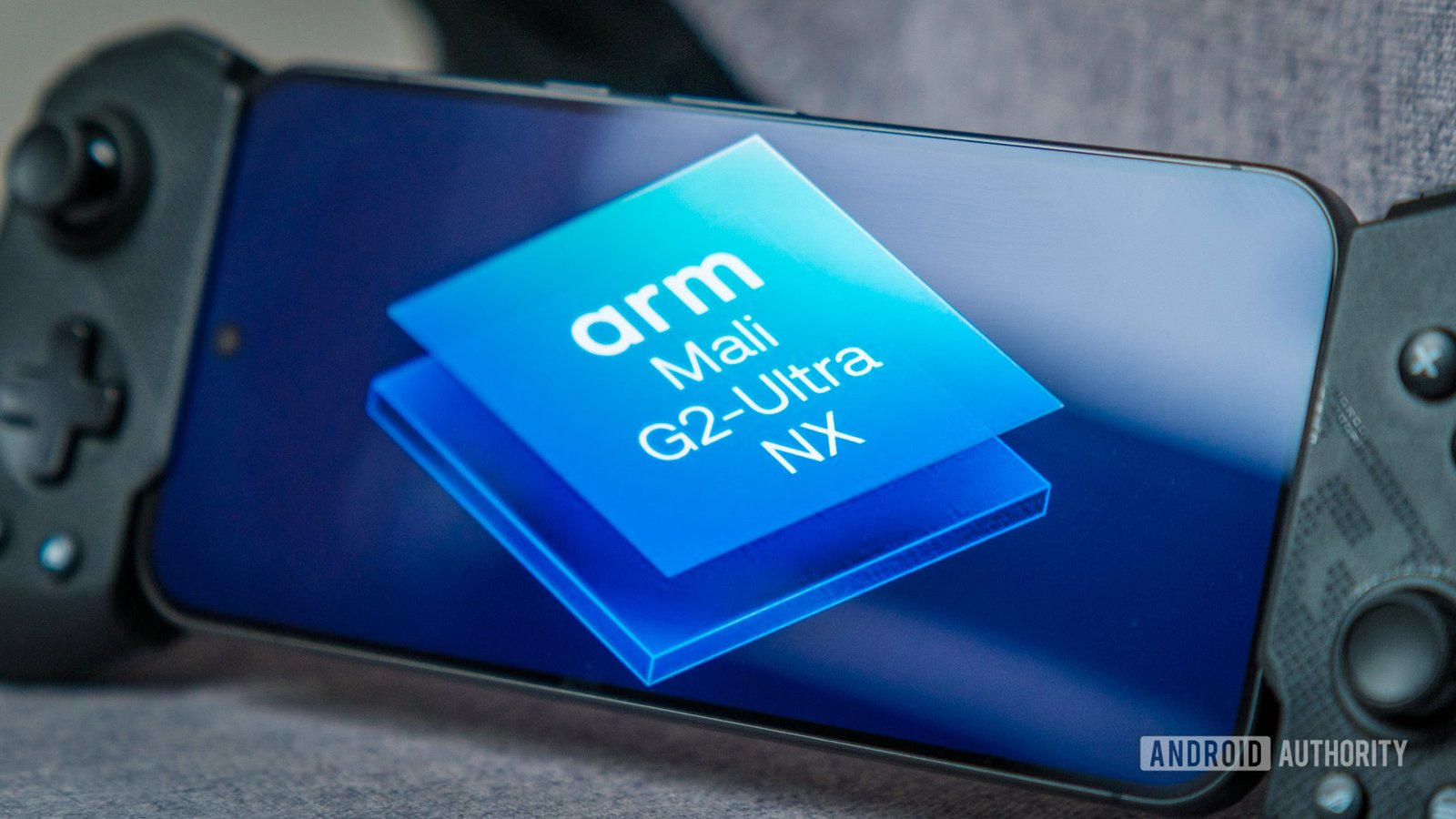

Robert Triggs / Android Authority
to add Android Authority On Google:
Mobile graphics have increasingly closed the performance gap with integrated desktop-class GPUs and even kept pace with the most advanced rendering technologies and features found in gaming consoles and PCs. Beam tracking is one of the latest examples, bringing a scaled-down, lightweight version of power plant lighting technology to our pockets at a fraction of the electricity.
But in the meantime, desktop-class GPUs have stepped up to the plate with neural network-assisted upscaling and frame rate generation, enabling 4K/120fps gaming without traditional rendering effort. Mobile phones are catching up here too.
If your next smartphone has the recently unveiled Arm Mali NX GPU, it will boast advanced AI-powered scaling.
Meet the Arm Mali G2-Ultra
Before we get into the AI improvements found in this year’s Mali graphics chips, we need to dive into the underlying architecture and portfolio changes in the G2 series.
If you’re looking for raw performance numbers, Arm lists many results. Comparing the 14-core Mali G1-Ultra reference platform to the G2-Ultra equivalent, gaming performance increases by 9% (Honkair Starrail) to 14% (Fortnite) (even with a shader core clock difference of 1.53GHz and 1.70GHz). On the high end, Arm expects we’ll see a 17-20% performance improvement in the most demanding mobile graphics benchmarks.
Generation-to-generation improvements in rasterization in general are modest, but that doesn’t mean things haven’t changed. The execution engines have been updated to support much larger desktop-class shaders, with each register doubled (now 128 instead of 64), as well as dynamic allocation that supports a wide 16-step range from 16 registers to 128 registers. This allows Unreal 5’s advanced graphics shader technologies, such as Lumen and Nanite, to operate without register overflow and the corresponding performance drop from DRAM access. It marks Arm’s biggest change to Mali in seven generations.

The G2 architecture also sports Arm’s third-generation ray tracing unit, which offers compact triangular imaging that uses shared edges to reduce data duplication and fit more geometry into the cache. Improvements in this generation of Arm reduce DRAM traffic by 13%, eliminate bottlenecks and improve energy efficiency.
The G2 series also supports hardware-accelerated transparency micromaps for the first time, making desktop-quality rendering with ray tracing even more possible in a mobile form factor. The integrated core reference design promises approximately 18-24% better ray tracing performance than its predecessor, depending on the benchmark.
NX explained — AI inside the GPU

OK, those performance figures are pretty decent, but Arm’s biggest announcement is undoubtedly the introduction of native AI support via the new NX Neural Accelerator. NX is a tightly integrated, optional hardware accelerator inside the GPU shader core for performing neurographic tasks with as little as 1W power consumption.
The tightly coupled neural accelerator supports INT8 and INT16 operations and includes its own motion engine processing unit, which we’ll cover later. The NX core also has its own clock frequency that runs up to 2x the main GPU clock using the same voltage, and shares memory with the rest of the GPU subsystem to ensure memory coherency.
The headline numbers certainly sound impressive. The NX Arm’s Neural Dawn demo can go from an unplayable 15fps to a stable 60fps with a power budget of just over 2W. This is a 4x increase in FPS and increased efficiency, paired with a 70% reduction in DRAM memory traffic compared to last year’s G1-Ultra graphics core.
Of course, there’s a trade-off here: Achieving this level of performance uses 2x Neural Super Sampling and Denoising (NSSD) upscaling from 540p to 1080p, which also performs ray tracing on the same pass. The next step uses Arm’s Neural Frame Rate Scaling (NRFU) to double the frame rate from 30 frames per second to 60 frames per second. Arm claims the end result is a more detailed image, higher frame rates and lower power consumption. However, I would be interested to see how the latency feels and what artifacts I might notice. Arm did not elaborate.

Unlike a generic extender (like TAA), Arm’s Neural Super Sampling is trained on real game data, allowing the neural network to recover fine details and data using a quarter of the traditional input data. You may be familiar with this idea from NVIDIA DLSS, AMD’s latest FSR, and even Intel’s XeSS 2. Qualcomm’s next-generation mobile GPU follows a similar idea. Arm claims its approach improves transient stability, reduces jitter and ghosting. Using a history buffer certainly helps here too, and there’s integrated anti-aliasing that eliminates the need for a separate pass. NSSD (NSS with denoise) is an advanced version of the technique that denoises raytracing results as part of the upscaling pipeline.
Neural frame rate upscaling also doubles the input frame rate, but its implementation is more complex to avoid introducing disturbing visual artifacts. It takes the depth and motion vectors from the two pairs of frames, and the hardware accelerates the “optical flow” estimation outside of the in-game vectors, feeding it all to the neural network to produce a new intermediate frame. Depth and motion frames are usually provided by the game engine, but the G2 architecture now includes a motion engine that determines the direction of motion between frames using a method similar to video encoding engines.
Three neural models of the arm at different stages of development. NSS was announced last year and NRFU has just been released. Both are available to developers via Hugging Face. NSSD is available early, but will be playable in 2026. All three require an NX-capable GPU to run, so they’re not backwards compatible with last year’s Mali G1 series.
Arm aims to make AI-powered graphics as viable as possible on its platform by supporting Vulkan ML for a wide range of applications and allowing its models to be saved and rendered every game. Only time will tell if this is enough to attract an even wider range of partners to start using AI-enhancement and ray tracing in their next-gen mobile games.
Development of a new generation mobile processor

To put it all together, there’s an even wider range of Mali configuration options than ever before, and things are getting a little too complicated. As before, the Ultra range offers the highest core count between 10 and 24 shader cores to scale up to laptop-class performance. The Ultra branding will be added to the NX branding, as it should include at least one NX core, and there is also talk of adding ray tracing support, but this will not change the naming scheme. The G2-Premium range is a mid-range mobile option with six to nine shader cores, optional NX branding and optional ray tracing if at least one core is available. Finally, the budget “Pro” segment again serves five cores and below with additional AI acceleration.
There are a total of five possible configuration groups: G2-Ultra NX, G2-Premium NX, G2-Premium, G2-Pro NX and G2-Pro, with some variations in these brackets. Confused? Me too. Either way, we’re probably looking at around 12-core versions for premium smartphone platforms, no doubt with around half the NX cores and ray tracing support.
Bringing “fake footage” to mobile is sure to be a controversial topic in some circles, and I’ll admit that I’m hesitant to see developers rush to market and rely on AI techniques to compensate for the lack of traditional optimization. Still, mobile devices can benefit much more from AI-powered graphics rendering than desktop and console players because of their more conservative power budgets for high-end rendering.
If Arm’s claims that the titles look good but run smoothly and our batteries can last longer are true, I’m all for it.
Thank you for being a part of our community. Please read our Feedback Policy before posting.