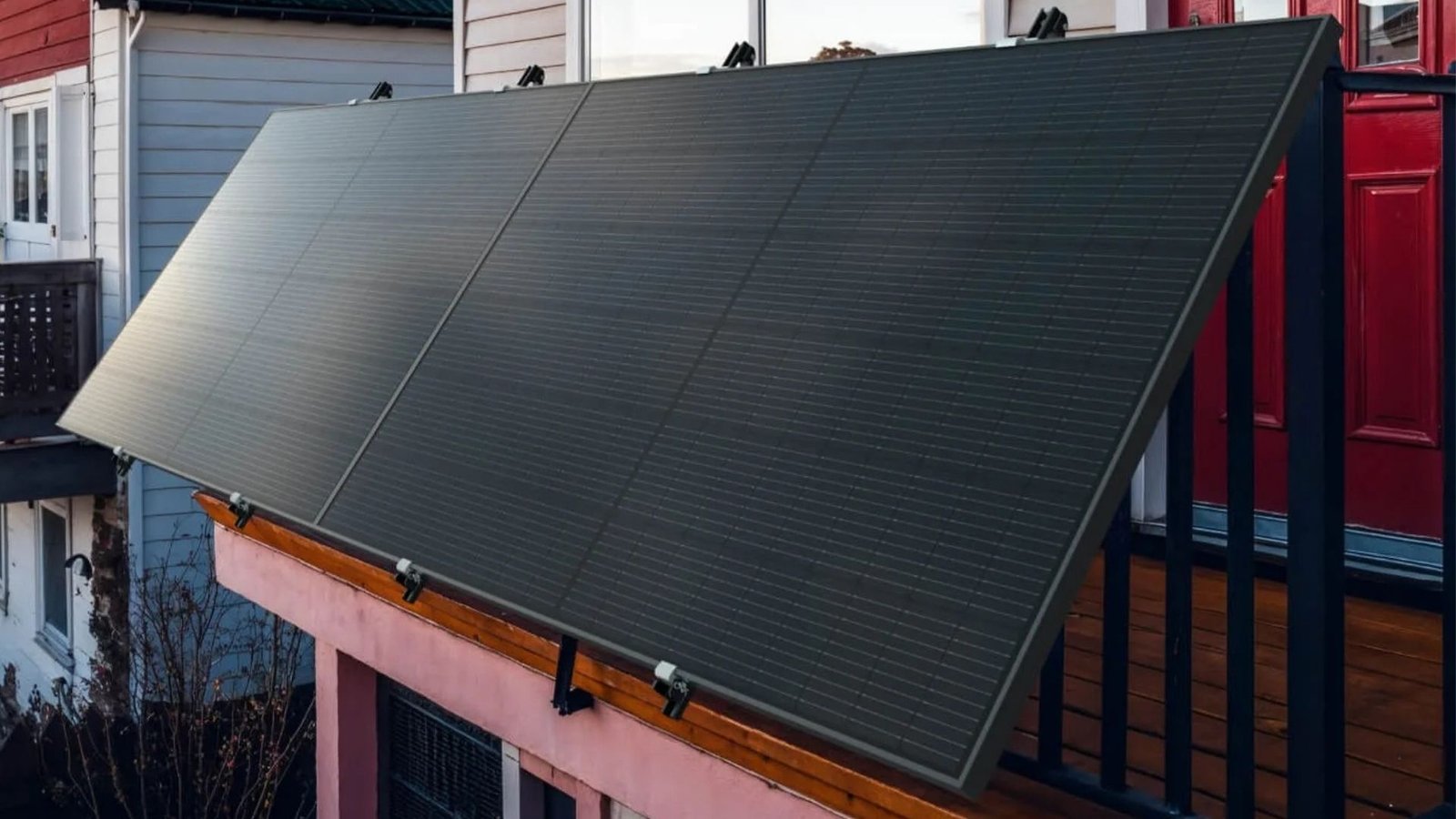
As of August 27, plug-in solar panels became legal in the UK. This means that every household can benefit from greener energy without having to spend ridiculous amounts of money on solar panels.
Solar panels are no longer reserved for those with, say, disposable income. With the panels promising to start at around £400, they’re not cheap, but they’re certainly more accessible to a lot more households than a £15,000+ set-up. And what’s most important to me is that you don’t need permission to install plug-in tools either.
What is a plug-in solar panel?
In case you missed it, plug-in solar panels are much smaller than traditional systems and connect to a standard UK outlet via a microinverter. They work by harnessing the sun’s solar energy to create direct current (DC). This direct current passes through the microinverter and converts it into alternating current (AC). From there, you can use this energy to power your appliances without relying on the grid.

The beauty of the plug-in solar panel
As someone who has rented countless apartments throughout my adult life—all in varying states of disrepair, but that’s for another day—I know I’m at the mercy of my landlords and their ironclad leases. And that means I can’t make major changes to the property.
Although I can almost live with the questionable design options, the doors hanging off the hinges and the uneven stairs, as a renter I have always missed the opportunity to use solar energy. I mean, it’s literally free energy that’s not only better for the environment, but saves you money! Why not make the most of it? But of course I never thought I could reasonably ask a farmer to splash on my behalf.
That is why the government’s introduction of the plug-in solar panel is so exciting, as I do not need to apply for a landlord’s permit, as this does not mean a big change to the building. And most importantly, if I ever move, I can simply take my panels with me and set them up again.
I have to reject the government’s advice to inform the owner that they are buying an inset panel. A landlord cannot refuse a plug-in unless there is a very good reason, such as security risks or limited space.
Reducing energy bills
As plug-in solar is very new to the UK and we haven’t tested any systems yet, we just don’t know how much we could save. To comply with UK legislation, plug-in panels cannot exceed 800W – a much lower rating than conventional solar panels, which require expensive, professional installation. With this in mind, of course, you can’t expect to save as much as your neighbor with the fancy equipment.
Despite this, the government said plug-in panels could save households “up to £110 a year” on their bills, while each plug-in solar kit could cover “20% of the average home’s electricity use”.
Of course, the exact amount saved depends on how much sunlight the panels receive. It’s a shame that the legalization of plug-in panels in the UK came rather late in the year, especially as the sun has been out in full force for the past four months.
Where can you buy plug-in solar panels?
The government has confirmed that you will be able to buy plug-in solar panels from major retailers such as Currys, B&Q, Screwfix and Amazon. It has also been said that stores such as Lidl and Iceland will also be stocking approved plug-in panels, meaning you can only fit one panel in your weekly shop.
However, at the time of writing, retailers have not yet confirmed prices for plug-in solar panels. This is a concern as although the government has said you can expect panels from £400, this is only a rough guideline. If the panels are more expensive, it may be more difficult for most households to swallow. In fact, realistically, £400 is quite a high asking price for most homes.
With this in mind, I really hope that the government will introduce incentives to help make panels more affordable for all households. Low income homes in particular are those who would appreciate lower energy bills but may not be able to afford the £400+ panel.
\