Perhaps the best gift you can give your children is the experience of failure. It sounds radical, perhaps a little uncomfortable, especially when so much of parenting is sometimes about trying to protect children from frustration and disappointment. But by jumping in every time things get tough, we can also rob them of developing the skills they’ll need to navigate an increasingly unpredictable world.
The question has become increasingly urgent as artificial intelligence changes the way we think about work. An earlier one He got up ahead conversation, I explored what happens when artificial intelligence begins to take over tasks and skills that once required years of training. The challenge is not simply to predict which jobs may disappear. It’s trying to figure out how to prepare people for a job market where skills that are valuable today may not seem so valuable a decade or two from now.
Children growing up today enter this world without knowing exactly what it will look like. Some of the jobs that are eventually pursued may not yet exist. Two decades ago, working for a YouTube creator would hardly have been an obvious career aspiration; today it is a perfectly acceptable profession. Rather than trying to figure out the exact careers that might emerge, it makes more sense to focus on the human skills that can travel from one situation to another: curiosity, judgment, problem solving, and persistence.
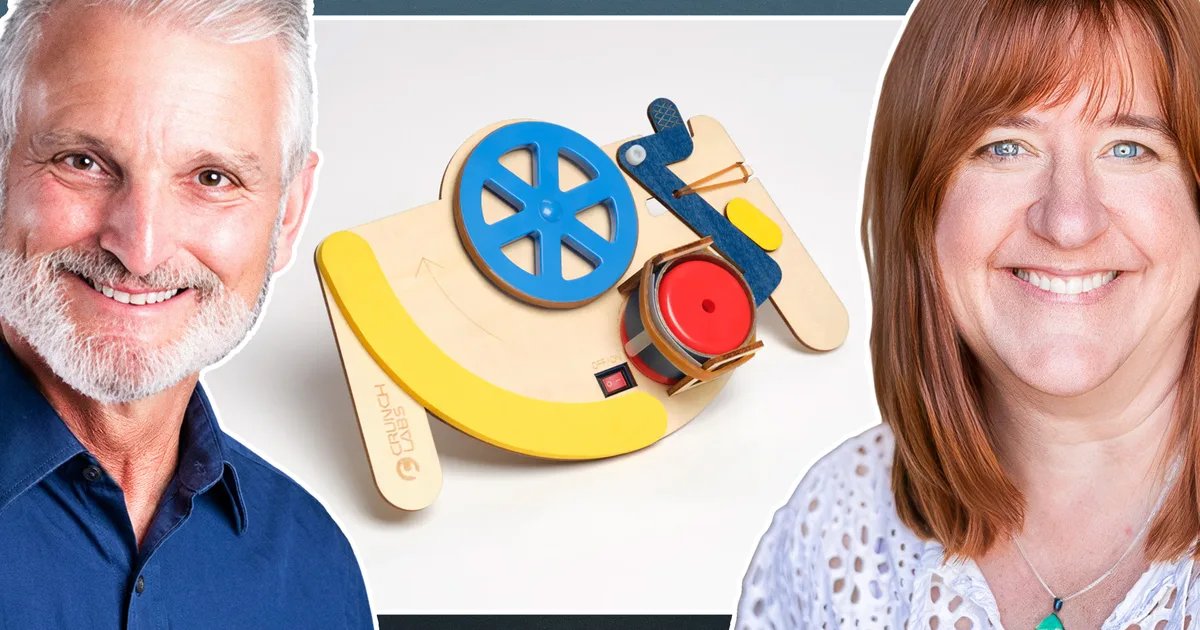
These ideas were the focus of my latest work He got up ahead a conversation with Rachele Harmuth, Chief Product Officer of CrunchLabs, an education and entertainment company founded by former NASA engineer and YouTube creator Mark Rober. Already knowing the company’s approach to the interview. Years ago I bought a CrunchLabs Build Box subscription for one of my grandsons and spent hours building projects with it. The projects were clever and really educational, but what stood out was that they didn’t always come together perfectly on the first try.
Looking back, I suspect the failed attempts were at least as valuable as the finished projects.
AI is changing what children need to learn
For generations, education has placed great emphasis on the collection of information and the acquisition of established skills. Children learn dates, formulas, languages, coding and other sciences with the expectation that these skills will prepare them for work later on. Knowledge still matters, but artificial intelligence is making it increasingly easy for machines to perform many tasks that once depended on a human being able to recall information or execute a process correctly.
The more difficult question is what happens when there is no clear process to follow.
Harmuth and I talked about how difficult it is to predict which careers will flourish 15 or 20 years from now. The answer is not simply to identify today’s most promising technical skills and teach them to all children. By the time today’s eight-year-olds enter the workforce, the technology around them will almost certainly change. Teaching them how to approach unknown problems, how to overcome uncertainty, and how to keep going when the first solution doesn’t work may be a better investment.
CrunchLabs summarizes this philosophy in one simple sentence: “Think like an engineer.” We’re not suggesting that every kid who builds one of their projects ends up designing bridges, developing robots, or working for NASA. In this context, engineering is a problem-solving mindset: define what you want to achieve, think about possible solutions, test one, understand what went wrong, and make the adjustment.
At the heart of this approach is curiosity, creative confidence and the ability to embrace failure. The first two are relatively easy for adults to understand. The third is much more difficult.
Making failure less threatening
Parents and grandparents naturally want to work things out. When we watch a child struggle with a puzzle, an assembly step, or a new skill, the instinct can be almost automatic: move that piece, turn it over, let me show you. Sometimes intervention is necessary, but removing all barriers also takes away the opportunity to discover what happens when you go through frustration yourself.
Harmuth made an interesting comparison during our conversation. Children already understand this process when they play video games. No one expects you to pick up a controller and beat a difficult game on your first try. If it fails, restart, change your approach, and try again. A failed attempt is not proof that you are unable to play. In many ways, this is how you learn to play.
The physical world often elicits a very different reaction. A drawing does not turn out as expected and the child decides that he is bad at art. An instrument screeches and suddenly they are not musical. The construct will fail and the conclusion will be, “I can’t do it.” The problem is not the failed attempt itself; it is the meaning we attribute to it.
Mark Rober’s work offers a useful counterexample. His videos showcase remarkable inventions, but the finished work doesn’t tell the whole story. Behind the polished result are failed ideas, prototypes and non-working iterations. This willingness to show these failures is part of what makes his approach to engineering accessible to children in the first place.
CrunchLabs applies the same philosophy to its products. Build Boxes introduce younger kids to hands-on physics and engineering projects, and Hack Packs give older kids a chance to explore robotics. The company’s CrunchLabs Mysteries books take the idea into a different format, turning reading into a hands-on STEM adventure and asking kids to solve puzzles and make their own tools. I recently looked at the extension of storytelling and it reflects the same underlying idea: STEM is not about sitting down and being told what to learn. This may involve making something up for yourself.
The company is also expanding into retail, summer camps and Class CrunchLabs, a nonprofit initiative that offers free STEM curriculum for grades 3-8. for class. The formats vary, but the lesson remains remarkably consistent: try, fail, learn, adjust, and try again.
Resilience is a teachable skill
My favorite moment in our conversation was Harmuth’s take on resilience. Resilience is often treated as an innate quality – you either have it or you don’t. Harmuth says it’s actually a muscle built from specific skills: problem-solving, persistence, and adaptability.
Parents can help build these skills without intentionally making childhood difficult. A child working on a skateboard trick, learning an instrument, writing a story, experimenting in the kitchen, or building a backyard fort is doing much of the same mental heavy lifting as a child working on an engineering project. Something isn’t working, so they have to figure out why, adjust it, and decide what to try next.
Curiosity makes the child wonder what might happen if he tried something different. Creative confidence gives them the belief that they can figure it out. When the first attempt fails, flexibility helps them move past “I can’t do this” and toward the more helpful question, “What should I try next?”
These habits can become especially valuable as artificial intelligence becomes more responsive. People still have to decide which questions are worth asking, evaluate whether the answer makes sense, and figure out what to do when the problem in front of them doesn’t have an obvious solution.
Skills for the future that we cannot predict
None of us can say with confidence which careers will flourish 15 or 20 years from now. Many of the jobs that kids do today may not even exist yet. Two decades ago, the idea of working for a YouTube creator as my dream job would have sounded absurd. Today, this is a perfectly acceptable career path.
Preparing children for a particular version of the future may therefore be less useful than giving them skills they can carry into the future. Curiosity, judgment, problem solving and persistence are not tied to a specific profession. They can serve a child who will become an engineer, an artist, a teacher or something that we have not even thought of calling a career.
“Think like an engineer” works as a philosophy precisely because it’s not really about engineers. The process is pretty simple: figure out what you’re trying to achieve, think about possible solutions, test one, see what went wrong, and adjust. A child does not need to know anything about engineering to benefit from learning how to approach a problem in this way.
Years after buying the CrunchLabs Build Box for my grandson, I think differently about projects we build together. The fun was part of the satisfaction of getting to work, but the moments when we had to stop and figure out why something wasn’t working might have been more important. The correct answer was only part of the experience. It was also important that they learn how to get there.
Parents naturally want to make things better for their children. We see the frustration and want to make it go away. Sometimes help is just what a child needs; other times, giving them space to struggle with a problem a little longer may be a more valuable response.
The world that today’s children will inherit will be shaped by technologies that we cannot fully foresee, and the jobs they will do may be very different from the jobs we know today. Preparing them for this uncertainty doesn’t necessarily mean teaching them every new technology as it arrives. This may mean giving them the confidence to face something unknown, giving them the flexibility to fail without losing heart, and giving them the curiosity to keep experimenting.
My conversation with Rachele Harmuth made me realize a simple thought: we may not be able to prepare our children for every problem they face, but we can help them to better process them. Even if they never become engineers, learning how to think can prove to be one of the most useful things they can do.
\