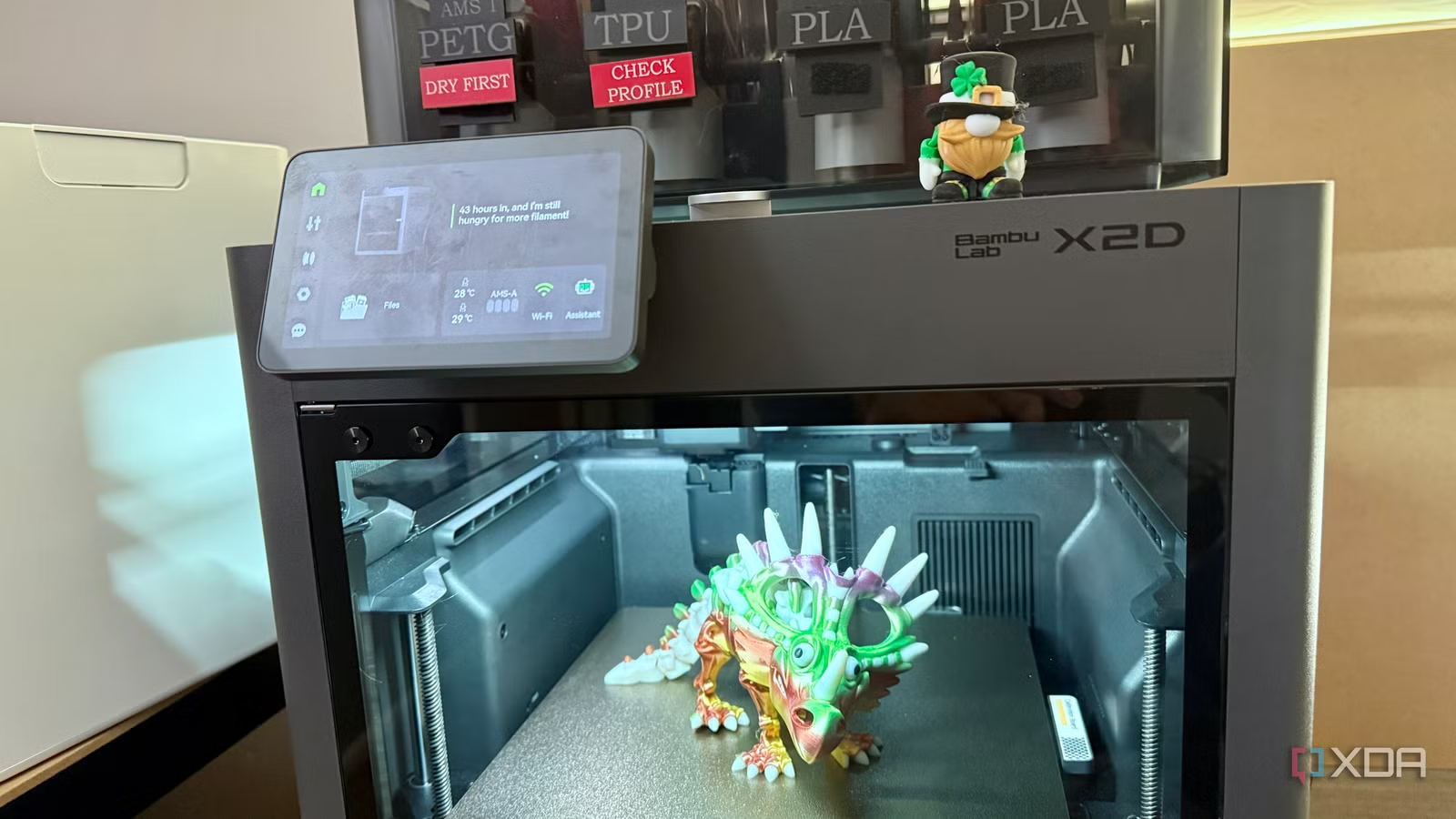
For a long time, TPU was the thread I owned without any reason to use it. PLA has handled almost everything I print on a regular basis, and PETG has handled the jobs where I wanted something stiffer or a little more heat resistant. The TPU was mostly sitting there because flexible printing seemed useful in theory, but I didn’t do many projects that required them. That changed after I stopped looking for “TPU projects” and started noticing household annoyances that hard plastic doesn’t solve well.
TPU has finally gotten some grip on my desk accessories
The hard plastic legs kept sliding when they weren’t supposed to
One of the least interesting TPU prints has done the most to change my opinion of the material. I’ve had some lightweight desk accessories that were perfect until I touched them and they would slide across the desk instead of staying in place. Printing feet or pads from PLA didn’t solve the problem because they were still hard plastic on a flat surface. The TPU gave me the same basic shape, but with enough grip to keep the object from moving every time I plugged something in or pulled something out.
It seems too small to run a 3D printer, but these are the types of problems that can be annoying with repetition. I don’t think much of something that slips up once. I noticed it after putting it back on for the twentieth time. Instead of giving the object a nice looking base, the little TPU pad solved the actual problem.
On the plus side, I didn’t have to design any tacky rubber feet off the web or out of the box. I could make the pads the size and thickness I wanted, and then fit the piece to the piece, not to them. There’s nothing particularly clever about the little TPU rectangle, and I wouldn’t have thought of it as an interesting print before. It was the type of print that made me remember TPU.
Flexible tension relief made for one annoying cable action
A little more flexibility worked better than the other cable holder

I’ve printed a lot of solid cable clips and guides, and most of them do what they’re supposed to do. The challenge begins when you need to hold the cable in place without forcing it into one fixed position. The PLA clamp can hold the cable neatly while also creating a tight bend where I don’t want it. At this point I technically organized the cable, but I messed up the actual routing.
The TPU worked much better for the small deformation-relieving part, because the printed part could bend with the cable instead of fighting it. It still held the cable where I wanted it to be, but didn’t have a hard edge to act as a new flex point as the cable moved. I can support the cable without attaching it completely. The difference didn’t seem to matter until I tried it and realized that the flexible part worked without all the hard clips I’d printed before.
This is probably the moment TPU stopped feeling like “soft PLA” to me. I approached it with the same types of designs I use for solid yarn, which doesn’t make sense when you think about it. If the part needs to bend, compress, stretch a little, or pass under pressure, TPU is much more interesting. When I started thinking about sleeves, strains, grips, and flexible contact points, the material suddenly became a much longer list of possible jobs.
A flexible bumper stopped one annoying cabinet noise
Sometimes useful printing is not noticed until later

The third fix is a closet door that closes tighter and tighter than I would like. I could have printed a solid spacer, but that would have changed where the door stopped without doing much about the strike itself. The TPU bumper may compress slightly when the door meets. It was a feature I needed, not just another piece of plastic between two faces.
I’m also not limited to a general round adhesive bumper, regardless of the thickness of the casing. I can expand the contact area, adjust the thickness, and shape it to where I want it. It’s a small advantage, but I use it all the time with useful 3D printing. Store-bought pieces are usually designed to fit hundreds of situations well, and I need a piece that fits just right for one situation.
The best thing about this fix is that once it’s installed, I stop thinking about it. No one will notice the little TPU bumper and ask where I got the model from, and it’s certainly not the type of print I’m showing. The cabinet stopped making noises that were annoying me. I was so fond of printing that I forgot that the end result was a problem before.
TPU still asks more from the printer
Flexible filament isn’t as messy as regular PLA

There’s still a reason why TPU spends so much time in my string drawer. PLA was ridiculously easy for everyday printing, and I rarely thought about the material itself. TPU is flexible before it reaches the nozzle, which makes it useful later, but can make it easier to handle. I can’t get PLA to do the job because there’s usually no reason to make it difficult to print easily.
The important part is that TPU allows my printer a category of repair that PLA and PETG don’t cover very well.
Flexibility is not automatically beneficial. I looked at a piece and wondered if TPU would somehow make it “better” when I needed something stiffer to hold its shape. Bending of the storage box is not required, as is the case with most mounting hardware. Most clamps work best when they are firm enough to snap into place without deforming when pushed.
Don’t assume that simple TPU will work through AMS or any other automatic material system. The soft thread can jam when the feeder tries to push it down the long thread path and Manufacturers like Prusa still recommend bypassing their multi-material system for standard TPU. Some newer filaments are specifically designed for automatic feeders, including Bambu Lab TPU for AMS, so check filament and feeder compatibility before loading it.
So the TPU didn’t replace anything in my normal thread rotation. I still use rigid materials for the vast majority of household printing because most of these parts have to stay where I put them. Enclosures, organizers, fasteners, brackets, and containers generally don’t scream for flexibility. TPU is useful for a small group of jobs where stiffness is an issue.
It is this discomfort that TPU takes its place
The right material is more important than easy printing

The difference now is that I know when I need to put in the extra effort. I no longer automatically design around PLA if a part needs grip, compression, controlled movement, or some shock absorption. I did this without realizing it: first I chose the thread because it was familiar, and then I tried to compensate for the design material. TPU works best when I reverse that decision and ask what the part needs to be done before deciding what to print it from.
So I think TPU gets overlooked. Visible displays of flexible yarn focus on hard-to-bend parts because it’s an easy way to show what the material can do. My useful TPU prints were not at all impressive. They were small parts that took advantage of just enough flexibility to fix the hard plastic not fitting properly.
Before you reach for TPU, ask if the part actually benefits from grip, compression, flex, or shock absorption. If none of these properties are important, solid filament printing is easier and better suited to the job.
After I made a few of them, I started to notice the same material qualities throughout the house. Rubber soles, soft bumpers, pliable tabs, sleeves, straps, elastics, and little pads suddenly look less like things I need to buy and more like printable parts. I’m not interested in reproducing all the rubber components I’ve seen, and some aren’t worth the effort. The important part is that TPU allows my printer a category of repair that PLA and PETG don’t cover very well.
TPU deserves more than random new projects
The three prints that changed my mind about TPU are very simple: grip feet for desk accessories, strain relief for cables, and cabinet bumpers. None of them used a lot of filament, and none produced a particularly impressive object when the printer was finished. They were more useful. Each one fixed a recurring irritation because I was using the right material for the job instead of reaching for unusually stiff threads.
PLA still accounts for most of what comes out of my printers, and TPU can sit untouched for weeks at a time. I no longer see this reel as a special thread. TPU is now one of the first materials I consider, not the last, when the issue is friction, movement, compression or impact. That’s a good reason to keep it in the drawer rather than waiting for another novelty flexible print.

- Build volume
-
256 x 256 x 256 mm
- Print speed
-
1000 mm/s
- Materials used
-
PLA, PETG, ABS, ASA, TPU, PLA support, PLA/PETG support, ABS support, PA/PET, PET, PA, PC, PVA support; Carbon/glass fiber reinforced PLA, PETG, ABS, ASA, PA6, PAHT, PPA, PET
- Brand
-
Bamboo Laboratory
- Number of extruders
-
2
- Extruder
-
Direct drive (primary), Bowden (auxiliary)
X2D can even handle TPU on AMS, but you’ll need a specific TPU hardness and an updated engine for the device.