Judgment
The ATH-R30x are a great choice if you’re looking for entry-level, open-back studio reference headphones that deliver warmth and detail. They’re lightweight, with soft ear cushions, and at £85 they offer an affordable solution to open listening. There are some slight drawbacks, such as the non-detachable cable and a slightly tight fit for larger ears. And it’s worth noting that you can get the excellent Sennheiser HD 560S for around the same price
-
Warm, controlled and not tiring
-
Comfortable style with soft pillows
-
An airy, open-backed sound
-
At an affordable price
-
The cable is not removable
-
You can clip it around the ear
-
Not ideal if you need isolation
-
Better boxes cost about the same
Main features
-

Assessment price: £85
-
Open back reference design
They allow air to flow freely for natural, speaker-like sound transmission – but they don’t seal off the sound
-
40mm dynamic drivers
Tuned for flat, transparent sound reproduction, not bass-boosted sound
-
Lightweight frame
Designed to be used for long listening sessions without headband pressure
Introduction
The Audio-Technica ATH-R30x is an affordable wired open-back headphone focused on audio production. They are part of the brand’s R-series, which is all about sound that prioritizes precision rather than the typical consumer bass boost and raised treble. Like many wired headphones, they have an open back design to allow air to move freely, opening up a wider, more natural soundstage.
But it’s worth saying that audio production is hardly the only use case for a wired open back. In fact, my pair (the Sennheiser HD 560S) are among my most used boxes because there is so much to enjoy in a natural, detailed listening experience with a wide soundstage. You don’t always you want the “funky” V-shaped frequency response.
Wired open backs can also be good for podcasters, video editors and gamers, and I think they’re very attractive if you’re into classical and acoustic music genres, as the accuracy rewards focused listening. If you’re taking your first step into wired headphones, the ATH-R30x seem like a good place to start, as they give you all the essentials for a reasonable price of £85.
Unlike Bluetooth boxes, there’s no ANC, no battery, no app and no controls – you’re paying for design, ergonomics and driver quality. So whether you’re a podcaster from your bedroom, an aspiring low-budget mixer, or someone curious about ‘accurate’ sound, this is an affordable entry into an expansive hobby.
Planning
- Light, 210 g
- Removable and replaceable cups and headband
- Non-removable 3 meter long cable
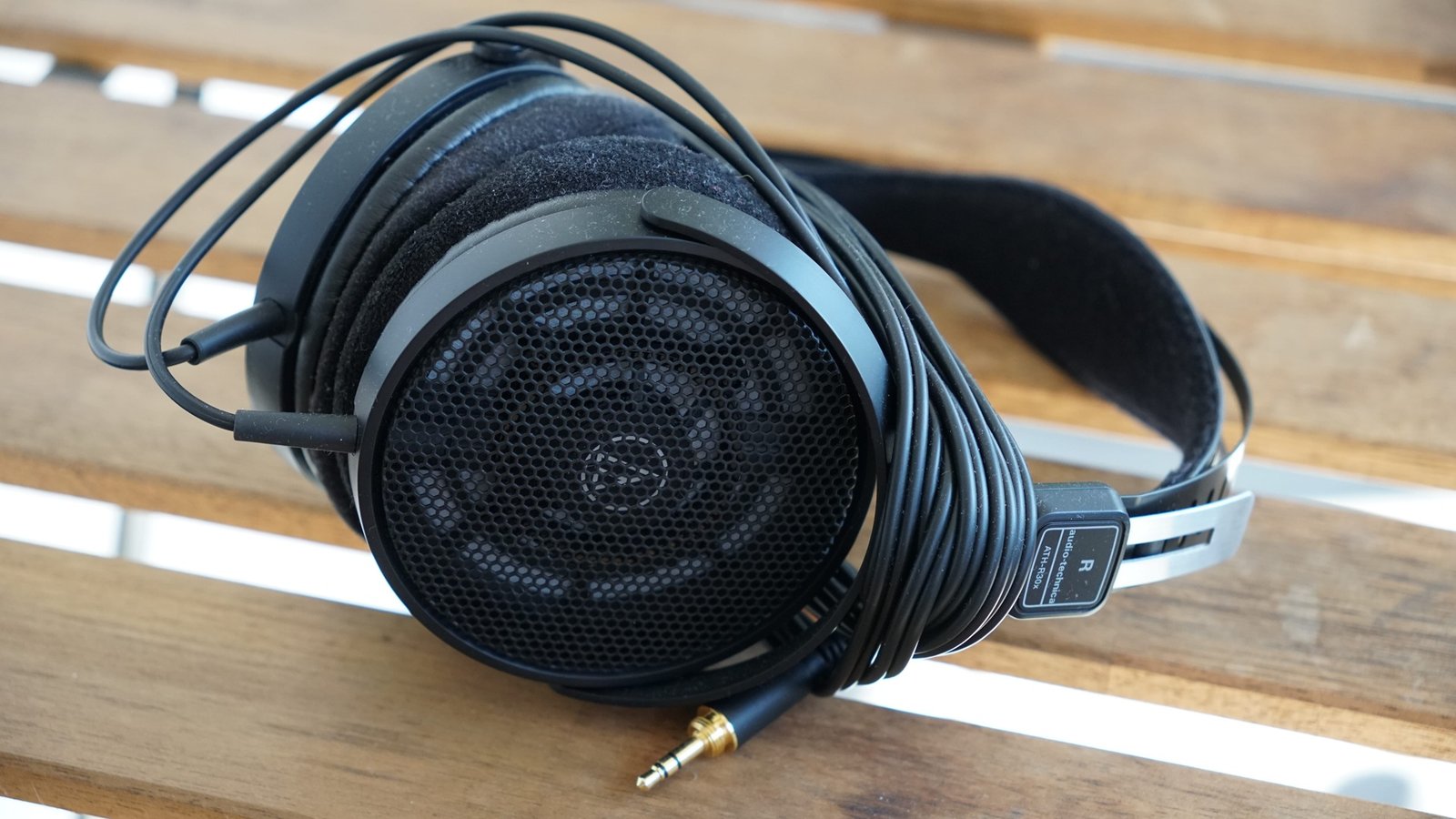
The ATH-R30x has a well-designed, minimalistic, utilitarian look. They have a black plastic frame, black metal mesh on the outside of the earcups (through which you can see the driver housing), and a suspended felt strap under the metal headband. It’s a good way to distribute weight evenly across the head and works well for long-term comfort.
The circular ear cup is on the small side. Comfortable to wear, they’re made of soft suede that feels plush and breathable compared to leather or synthetics, but I was very aware of the cups on the bottom and top of my ears. I don’t have the biggest ears and I found them easy to wear for hours at a time, but I will say they won’t suit those with larger ears!

They have a much looser grip compared to the Sennheiser HD 560S, which may be a better fit for some, but the Sennheiser’s larger and softer ear pads make them my top choice for comfort at this price point. However, the HD 560S weigh 30 grams more than the ATH-R30x’s 210 grams, so they’re better if you want something light. Any of these are lighter than battery powered wireless headphones.
It is important to note that the ATH-R30x does not have a detachable cable. It’s a fixed 3m cable, which is great for a studio desk, but quite long and unwieldy. I’ve found it caught between the wheels of my office chair a couple of times, so you have to be intentional about it.
One of the main advantages of wired headphones is that you can change cables, and you can’t do that here. With such a long cable, there is no need to connect it to a phone or laptop on the go!

Specification
- 40mm dynamic drivers
- Fixed 3 m cable
- 36 ohm impedance
As the cheapest model in the brand’s R series, we’d expect these to lack the technology of more expensive studio-grade headphones. Sound is handled by 40mm dynamic drivers, and Audio-Technica calls them a “professional open reference” model that delivers a spacious soundstage and natural clarity with minimal additional tuning or attenuation.

Yes, they are made for mixing, mastering and creating. But as mentioned above, nothing prevents you from using these boxes for casual music listening. They have a frequency response of 15 to 25,000 Hz and are low-impedance headphones at 36 ohms, meaning they can be easily driven directly from a phone or laptop without the need for a powerful amplifier.
Sound quality
- Warm and clear reference sound
- Honest and precise
- Excellent imaging and instrument separation
For sound alone, the Audio-Technica ATH-R30x are among the best budget wired open backs out there. I can think of little else that rivals these at £85; it’s just that the Sennheiser HD 560S now costs nothing more than its original RRP of £179, which normally retails for £99 these days. So would I recommend going with these or the newer R30x if you’re on a tight budget?
The R30x handles instrument separation beautifully. One of my first test tracks was Penguin Cafe Orchestra’s Perpetuum Mobile, with its simple melody and mix of piano, rhythmic strings and bass guitar. The R30x captures every element and sound in a balanced way, with everything clear and easily identifiable in the mix.

Moving on to pop music, I found these excellent for keeping the vocals front-and-center on Chappell Roan’s Good Luck, Babe, and captivating when playing Post Malone’s Sunflower. The precise imaging helped me hear backing vocals that I usually miss on the latter track, and the sound is smooth for easy listening.
They are slightly bass-light if you are used to the bass-forward sound. I didn’t find this to be much of a problem as they are still warm and full-bodied enough for my taste while being very clear for long listening sessions.

Unless you don’t mind low bass, I think these offer accurate sound at a reasonable price. If you spend a little more on the Sennheiser HD 560S, you get a slightly more analytical display and a slightly wider soundstage.
The R30x is just a touch warmer and less tiring for long listening sessions. Honestly, it’s a close race between the two.
But the Sennheisers’ detachable cable and added convenience means I’d vote for them if you’re deciding between them.
Should I buy it?
You want lightweight, open-back headphones with a fine grip
If you’re on a budget and want natural sound with great imaging, the impressive ATH-R30x has a lot to recommend it. They have a nice grip, soft suede ear pads, and a good fit and sound for long-term wear. At just £85, it’s a huge pair of headphones for the money.
You should use them in any noisy place
It is worth saying that it is not a good choice if you need noisy or public places. Sound leakage is significant and people nearby can hear exactly what you’re playing at about 60% volume. Also, if you hate long wires or want a detachable cable that you can replace if it gets damaged, this is not the right choice for you.
Final thoughts
Even if you’re not buying headphones for professional recording or mixing, the ATH-R30x are a great example of why wired, open-back models are the best choice if you’re looking for detail, instrument separation, and natural clarity. This is an excellent pair of boxes for focused listening and musical enjoyment.
They’re much cheaper than premium wireless headphones, but offer clear advantages for those willing to go with a cord. There are minor compromises, such as the 3m cord not being removable and the fit around your ears being a bit tight. Spend a bit more and you can get the Sennheiser HD 560S, which are fantastically open-backed for precise sound and have interchangeable cables and larger ear pads, but feel tighter on your head.
Overall, the ATH-R30x is a great value proposition as an entry point for critical listening or for home mixing and production that most people should be able to wear for hours on end with smooth, warm and detailed sound quality.
How to test
I spent two weeks transitioning the Audio-Technica ATH-R30x as my primary home listening headphones. I’ve connected them directly to mobile and portable hardware, including a MacBook Air, Activo P1, FiiO Snowsky Echo Nano, and iPhone 17 Pro (with Apple dongle).
Music listening was split between streaming from Apple Music, Spotify and Deezer, and high-resolution FLAC playback from digital audio players. In testing, I used the Sennheiser HD 560S as a benchmark to assess how the ATH-R30x compares to similarly priced open-back competition.
- Tested for 2 weeks
- Tested with real use
LIZARD
Not. With its low impedance of 36 ohms and adequate sensitivity, the ATH-R30x can be easily driven directly from a laptop, smartphone or tablet.
No, the ATH-R30x has a fixed 3 meter cable. If the cord is damaged, it cannot be disconnected and replaced like other models.
Full specifications
| Audio-Technica ATH-R30x review | |
|---|---|
| Manufacturer | Audio Technica |
| IP rating | Not |
| Weight | 210 g |
| ASIN | B0DYQ12RFJ |
| Publication date | 2025 |
| Connection | 3.5 mm |
| Colors | Black |
| Frequency range | 15 25000 – Hz |
| Headphone type | Above the ear |
| Sensitivity | 92 dB |
| UK RRP | £85 |
| US RRP | TB |
\