While we are hopefully over the worst heatwave this summer, experts are warning that warmer temperatures in the UK could be the new normal. With that in mind, now is the time to make sure your home is ready for the warmer weather.
This begs the question, is the humble fan enough to make it through even more heat waves? Or is air circulation a more versatile choice?
To make your decision easier, we’ve detailed everything from what an air circulation pump really is and how it works to how it differs from a fan, so you can decide which device is worth investing in.
When you’re done, be sure to check out our roundup of the best fans. If you think you need a small air cooler, our guide to air coolers and portable air conditioners will help you.
What is an air conditioner?
Although an air circulation fan is a type of fan, it works in a slightly different way. While a traditional fan works by blowing air where you point it, a recirculator moves the air throughout the room.
This means that while the fan provides immediate, more direct cooling, the air circulator cools the temperature of an entire room by redistributing the warmer air.

Do air conditioners really cool a room?
Unlike an air conditioner, which actively removes warm air from a room, cools it internally, and then pushes it back, an air recirculator does not actually cool a room. Instead, it distributes warm air with cooler air to create a more even room temperature. Additionally, recirculation helps make rooms feel less stuffy by dispersing stale air.
So, while they aren’t actually cooling devices, they help the room feel less warm and stuffy than it otherwise would.
Airflow and room coverage
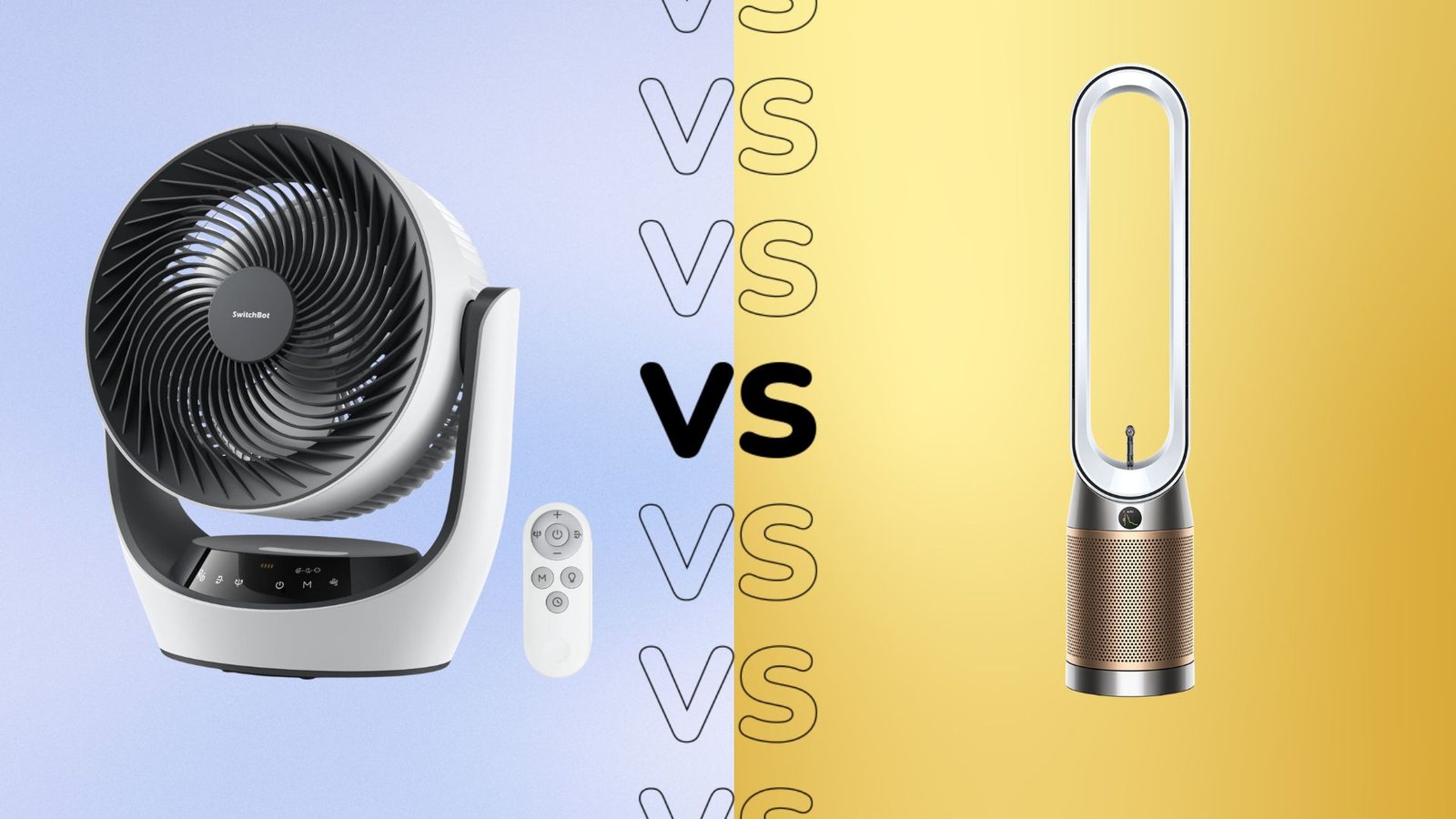
It should be said that different fans and air circulators offer different levels of airflow and room coverage. In our experience, we have found that air circulation pumps tend to provide stronger airflow, with the Switchbot battery powered circular fan seeing speeds of up to 2.5 m/s at 1 meter, while the MeacoFan Sefte can achieve speeds of up to 2.6 m/s at the same distance.
In comparison, we found that the Dr Prepare 13-inch tower achieved an airflow of 1.7 m/s, while the (much more expensive) Dyson Find+Follow Purifier Cool PC3 achieved 1.8 m/s when placed 1 meter away.

Noise levels
Some fans, especially older models, have a reputation for being quite noisy devices. However, newer models usually promise a quiet cooling experience. While we’ve tested a few fans that are a bit louder than we’d like, such as the Dreo TurboCool, which clocks in at 60.5dB, and the portable Shark ChillPill, which hits 67.9dB, newer fans generally can’t be loud enough to actively bother you.

Similarly, modern air conditioners should not be particularly loud. Take the MeacoFan Sefte 8” fan, which we concluded was “slightly quiet”, averaging around 43.5dB at level six and never exceeding 54dB – even at the highest level.
In addition, and as the name suggests, the Duux Whisper 3 is an impressively quiet device. Even at a maximum speed of 4.3 m/s at 15 cm and 2.6 m/s at a height of 1 meter, the sound did not exceed 52.1 dB, which is quite loud.

In general, although neither the fan nor the air circulation will be completely silent, unless you have an old or broken device, they should not be so loud as to disturb you.
Which is better paired with air conditioning or heating?
A recirculator is a solid solution for year-round use, as it generally works the same way with an air conditioner as it does with a heater. In warmer weather, pairing the circulator with an air conditioner will help distribute the cooler air from the AC more efficiently throughout the room.
Similarly, pair the circulator with a heater and it will help circulate the heat to create a more even temperature. This is particularly useful as warm air tends to rise while cooler air stays down, meaning heaters usually have to work a little harder to warm rooms.
In comparison, although you can pair a fan with an air conditioner or heater, remember that fans are generally designed for personal use. However, many fans, such as the Dyson Find+Follow Purifier Cool PC3 and the Dr. Prepare 13-inch Dual Oscillating Tower, provide oscillation, which can also help circulate air. They are just not as strong as a separate air circulation.
Which one should you buy?
There are a few things to keep in mind when choosing between a circulator and a fan. A traditional fan that offers a direct breeze is better for those who want personal cooling and don’t have a powerful air conditioner.
However, if you want a device that helps keep your room temperature consistent, it’s less stuffy and works year-round, as it boosts both air conditioning and heating.
\